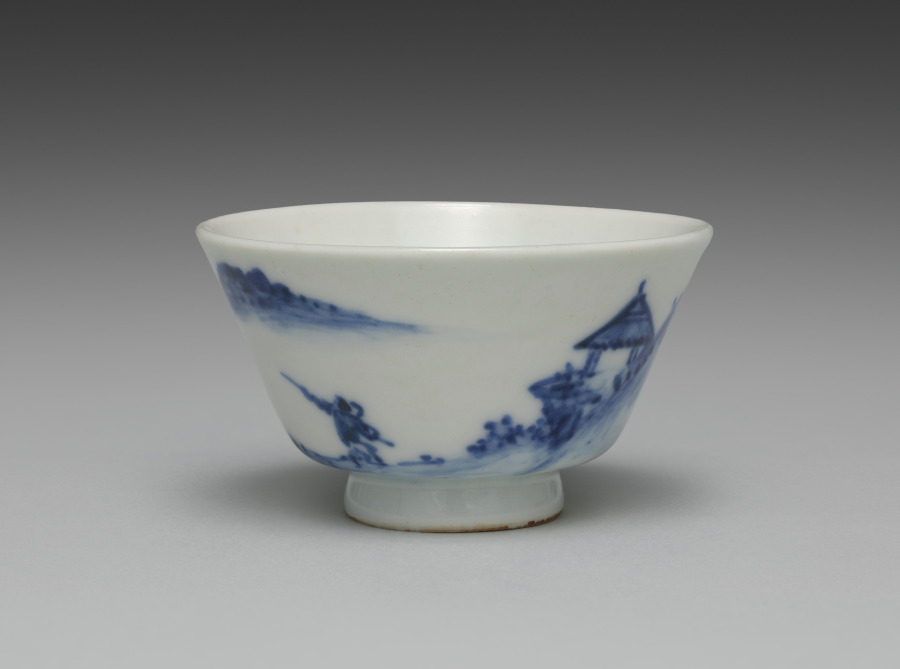
Originally from a set of 12, each of these 11 sencha teacups has a different landscape wrapped around the body, giving individual cups their own engaging narrative. These paintings are comfortingly familiar in their formulaic qualities, known to any casual fan of ink painting; they are also enjoyable in the way the narratives are revealed as one manipulates the cups. They would be perfect as conversation pieces for a tea gathering. Four of the cups focus on travelers approaching residences. Two have a person crossing a bridge as their central motif: one man has a backpack, and the other, a cloth-wrapped bundle hanging from a pole slung over his shoulder. Another cup depicts a pair of friends gathered together on rock platforms. A single cup shows a man carrying a furled banner toward a pavilion. The remaining three cups feature people riding in boats: two have literati passengers, and the third is occupied by a fisherman. Seifu Yohei IV’s training as a painter with Tanomura Shosai (1847–1909), an adoptive son of Tanomura Chokunyu, his father’s painting teacher, is evident in the details of the tiny worlds created on the cups.
View the original at Cleveland Museum of Art →Article 1 states the aim as a beautiful and dignified national land, and it covers not only cities but farming, mountain and fishing villages. Inside a landscape planning area, Article 16 requires advance notification of new building, extension, rebuilding, relocation, and any repair or alteration that changes the exterior. Landscape Districts go further and impose direct restrictions on the form and design of buildings.
The cool part. Read Article 16 to the end of the sentence. A change of colour is listed alongside new construction as an act you must notify. Repainting your building is, in law, the same category of event as putting up a new one. This is the machinery behind the muted shopfronts of Kyoto. The brown coffee-shop sign is not a marketing choice, it is compliance.
Verify at e-Gov 法令検索 →Use it Palette for a single-colour run: one ink, heavy stock, nothing else on the sheet.
Description source: museum curator text — not generated