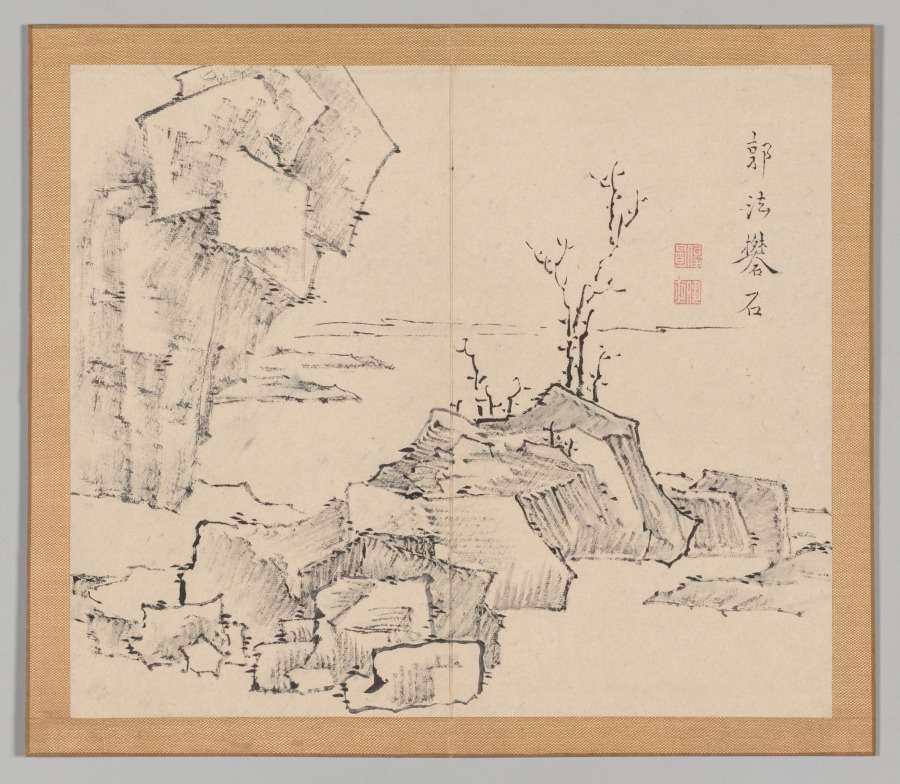
Aoki Shukuya was a student of painter Ike Taiga and inherited Taiga's artistic style. A surviving painting album by Taiga, which is kept in Kyoto in scroll format, was the basis for this painting by Shukuya and corresponding designs from a set of wood-block-printed books published in 1804. The postscript in the books, penned and carved by scholar Minagawa Kien (1735-1807), states that Taiga created the album as a gift for his wife and painter Tokuyama Gyokuran. Rocks with intricate formations are accompanied by the text "Guo's method for alunite" in the second volume of the wood-block-printed set and Shukuya's painting. This refers to Northern Song-dynasty painter Guo Xi (about 1020-1090, Chinese) and a pale mineral that forms from volcanic rocks when altered by hot, acidic water.
Aoki Shukuya was a top student of painter Ike Taiga and took responsibility for Taiga’s stylistic legacy. A painting album by Taiga, part of which survives today in Kyoto in hanging scroll format, served as the source for this painting by Shukuya and the matching designs from a set of wood-block–printed volumes published in 1804. The postscript to the books, written and carved by the scholar Minagawa Kien (皆川淇園) (1735–1807), explains that Taiga produced the original album for his wife and fellow painter Tokuyama Gyokuran (徳山玉瀾) (1727/28–1784). Complex rock formations are accompanied by the text “Guo’s method for alunite” (郭法礬石) in a design from the second volume of the wood-block–printed set and Shukuya’s painting. This is a reference to the Northern Song–dynasty (960–1127) painter Guo Xi (郭熙) (Chinese, about 1020–1090) and a pale, often whitish mineral that forms naturally when volcanic rocks are altered by hot, acidic water.
View the original at Cleveland Museum of Art →A national statute written for one city. Article 1 recites the beauty of Kyoto and its historically, culturally and artistically important position in the world, and gives two purposes: to raise international culture and serve the ideal of permanent world peace, and to contribute to the economic recovery of Japan. It was passed five years after the war ended.
The cool part. Article 3 lets Kyoto designate culture tourism preservation districts and, by ordinance, prohibit building, rebuilding, removal, changes to the shape of the land and the cutting of bamboo, trees and stone, with compensation for ordinary loss. Then Article 4 does something statutes almost never do. It places a duty on the mayor personally: in the spirit of local autonomy, and with the cooperation of residents, the mayor must engage in ceaseless activity to complete the city. Nara received its own Act, number 250, the day before.
Verify at e-Gov 法令検索 →Use it Take the ratio, not the picture. It sets a page better than a grid does.
Description source: museum curator text, translated — not generated