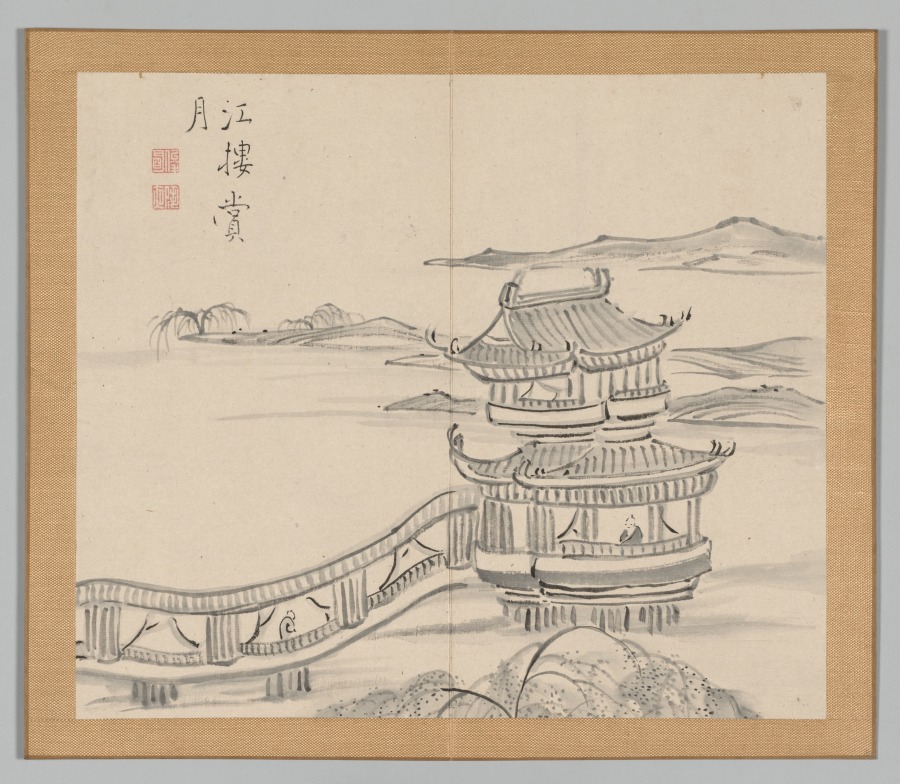
Aoki Shukuya was a student of Ike Taiga and inherited Taiga's painting style. A surviving painting album by Taiga in Kyoto, in hanging scroll format, was the inspiration for this painting by Shukuya and the accompanying designs from a set of wood-block printed books published in 1804. The postscript of the books, penned and carved by scholar Minagawa Kien (1735-1807), states that Taiga created the album as a gift for his wife and painter Tokuyama Gyokuran (1727/28-1784). The final design in the first volume of the books and Shukuya's corresponding painting feature the phrase "moon viewing from a river pavilion." This scene references a poem by Chinese Tang dynasty poet Zhao Gu (active mid-800s). In the poem, an individual contemplates the moon from a riverside pavilion and recalls the absence of a companion who had shared the experience with him the previous year.
Aoki Shukuya was a top student of painter Ike Taiga and took responsibility for Taiga’s stylistic legacy. A painting album by Taiga, part of which survives today in Kyoto in hanging scroll format, served as the source for this painting by Shukuya and the matching designs from a set of wood-block–printed volumes published in 1804. The postscript to the books, written and carved by the scholar Minagawa Kien (皆川淇園) (1735–1807), explains that Taiga produced the original album for his wife and fellow painter Tokuyama Gyokuran (徳山玉瀾) (1727/28–1784). The final design in the first volume of the books and Shukuya’s corresponding painting include the text “viewing the moon from a river pavilion” (江楼賞月). The scene alludes to a poem by Tang dynasty (618–907) poet Zhao Gu (趙嘏) (Chinese, active mid-800s). In the poem, a person gazes at the moon from a riverside pavilion and reflects on the absence of a companion who had admired it with him at the same place the year before.
View the original at Cleveland Museum of Art →Article 1 sets a purpose larger than preservation: to preserve cultural properties AND to make use of them, contributing to the cultural advancement of the people and to the progress of world culture. Article 4 turns that outward. An owner must recognise the object as a precious national asset, preserve it for the public, and make it public as far as possible. Ownership here carries a duty to show.
The cool part. "Living National Treasure" appears nowhere in the statute. Article 71 requires that when an Important Intangible Cultural Property is designated, the minister must also certify its holder or holding group. Japan does not register the pot, it registers the potter. Article 96 is the one that reaches ordinary people: if you uncover a shell mound, a dwelling site or a tumulus, you must leave it exactly as it is and notify the Commissioner for Cultural Affairs without delay, and the Commissioner can freeze the ground for up to three months.
Verify at e-Gov 法令検索 →Use it Two-colour foil on uncoated stock gets you most of this at production cost.
Description source: museum curator text, translated — not generated