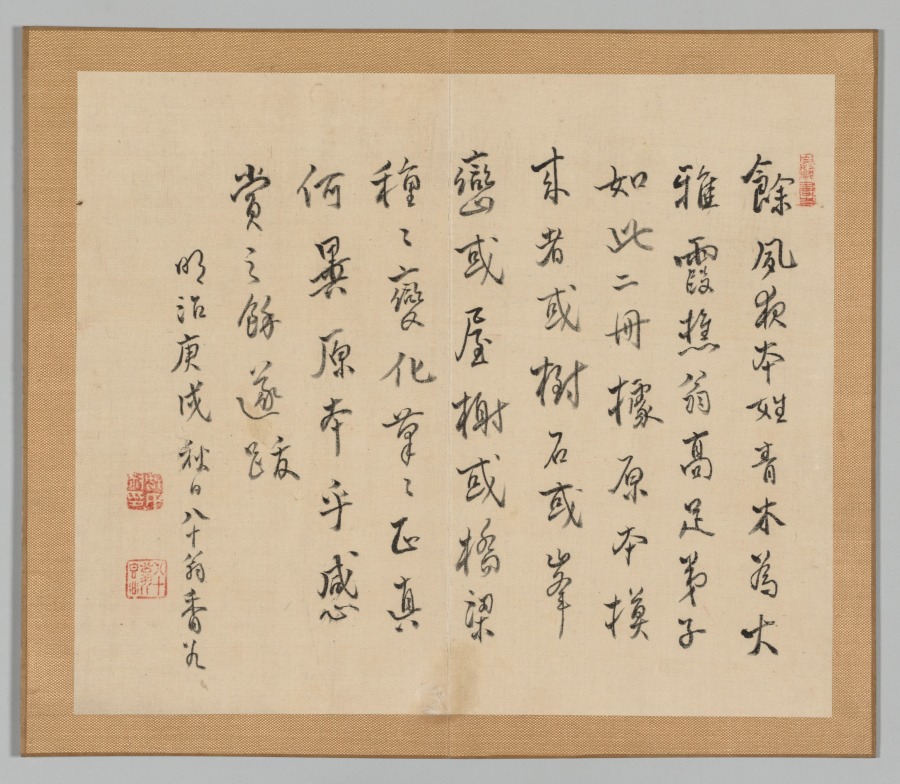
Kusakabe Meikaku, one of the three most renowned Japanese calligraphers in his era, created a title page, CMA 1979.73.1.1, for a pair of albums containing paintings. These paintings are replicas of Ike Taiga's (born in 1723, died in 1776) works by his student Aoki Shukuya (died in 1802). Murata Kōkoku, a painter with extensive connections in China and Japan, penned a postscript for the albums. He explained that the paintings are precise copies of Taiga's depictions of rocks, mountains, residences, and so on. Kusakabe and Murata respectfully recorded Shukuya's work over a hundred years after his demise.
Kusakabe Meikaku, one of the three most famous Japanese calligraphers of his time, provided a title leaf, CMA 1979.73.1.1, for a pair of albums of paintings after Ike Taiga (池大雅) (1723–1776) by his student Aoki Shukuya (青木夙夜) (died 1802). Murata Kōkoku, a well-traveled painter with an extensive network of colleagues in China and Japan, wrote a postscript for the albums in which he explained that the paintings are faithful copies after Taiga’s images of rocks, mountains, residences, and so forth. These two artists respectfully documented Shukuya’s work more than 100 years after his death.
View the original at Cleveland Museum of Art →Article 1 states the aim as a beautiful and dignified national land, and it covers not only cities but farming, mountain and fishing villages. Inside a landscape planning area, Article 16 requires advance notification of new building, extension, rebuilding, relocation, and any repair or alteration that changes the exterior. Landscape Districts go further and impose direct restrictions on the form and design of buildings.
The cool part. Read Article 16 to the end of the sentence. A change of colour is listed alongside new construction as an act you must notify. Repainting your building is, in law, the same category of event as putting up a new one. This is the machinery behind the muted shopfronts of Kyoto. The brown coffee-shop sign is not a marketing choice, it is compliance.
Verify at e-Gov 法令検索 →Use it The border is the idea. Use it as an edge treatment and leave the centre empty.
Description source: museum curator text, translated — not generated