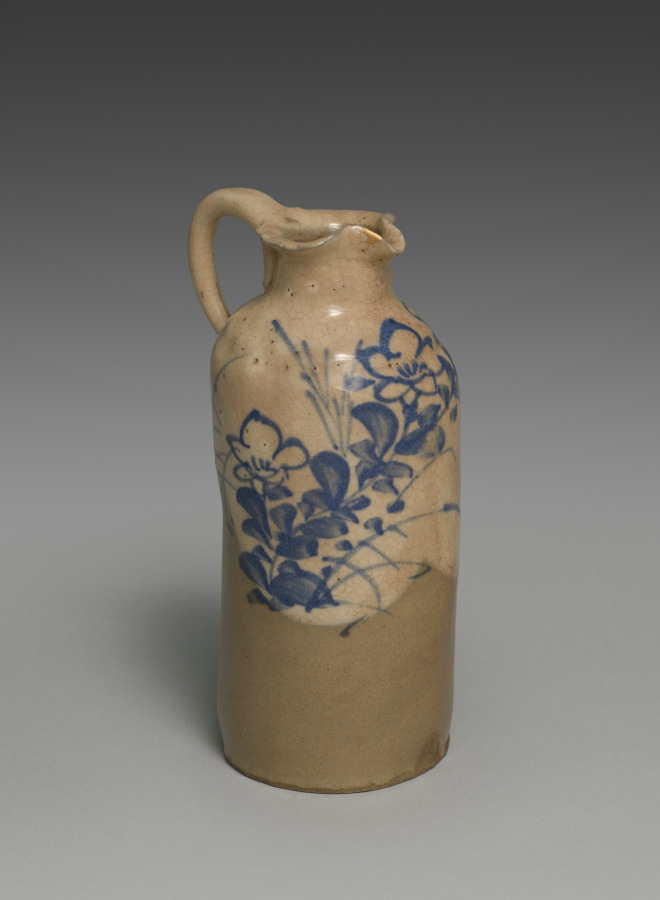
This pair of sake pourers adorned with with bamboo and bellflowers is attributed to the founder of the Seifū Studio, Seifū Yohei I (1801–1861). Yohei I, the lineage founder, was born to the Yasuda family in the city of Kanazawa, which faces the Sea of Japan. His home province of Kaga (in present-day Ishikawa Prefecture) produced its own ceramics, known as Kutani ware, but for his training as a potter, Yohei I chose Kyoto, which produced the more technically advanced porcelain ware. He moved to Kyoto around the 1820s and became apprenticed to Nin’ami Dohachi, a leading potter in the city. He later struck out on his own, and it is likely that his teacher gave him the name Seifu Yohei. His works include many exquisitely painted copies of Chinese porcelain, and he also produced stoneware with overglaze color enamels that emulated works in the style of Ogata Kenzan (1663–1743) at which his teacher excelled.
View the original at Cleveland Museum of Art →Article 2 defines a museum as an institution that collects, keeps and displays materials on history, art, folklore, industry and natural science for public use, carries out research on them, and which has been registered under Chapter 2 of this Act. The registration is not decorative. In law, an unregistered collection open to the public is not a museum.
The cool part. The definition of keeping is given as including raising. That single parenthesis is why a zoo, an aquarium and a botanical garden sit inside museum law in Japan: the collection is allowed to be alive. Article 1 also grounds the statute in the Social Education Act and the Basic Act on Culture and the Arts, which places museums in education first and culture second.
Verify at e-Gov 法令検索 →Use it A motif small enough to blind-deboss, which is where restraint actually shows.
Description source: museum curator text — not generated