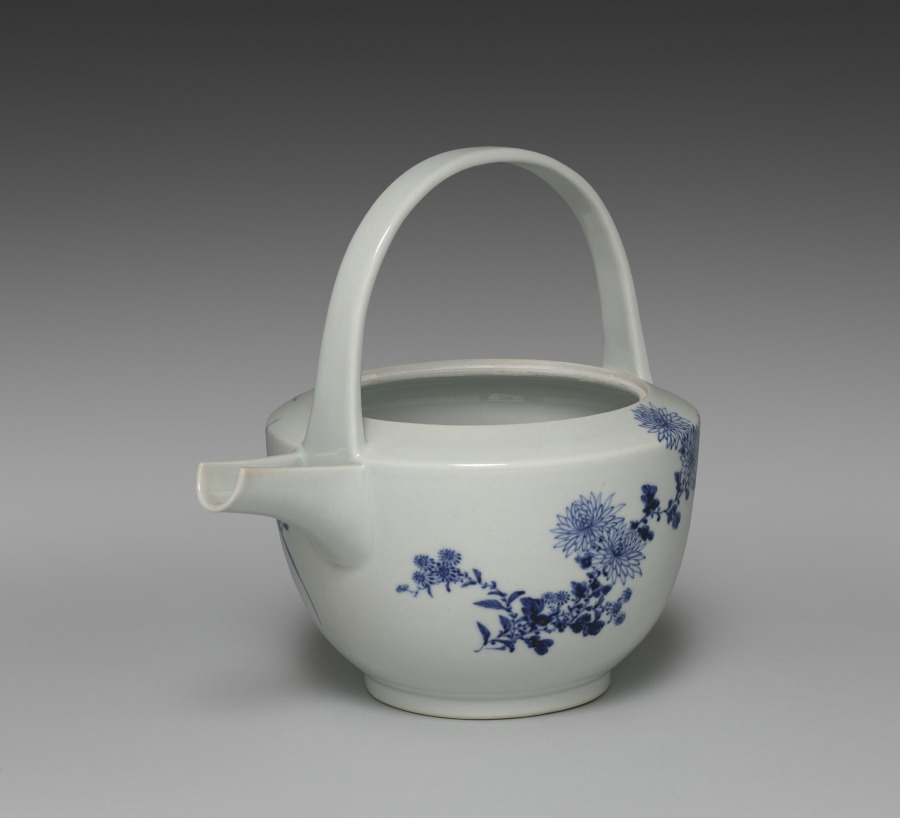
This sake pourers has a wide basin with a low foot; a generous spout open across the top half; a flat, round lid with a small knob recessed flush to the top of the container; and a tall, arched handle that meets the container where the top joins the basin at a sharp angle. It has a painting in underglaze blue of the Four Nobles: chrysanthemum, orchid, plum, and bamboo. Unlike the creamy white color of some Yohei III works, the white of this sake pourer has the bluish cast typical of porcelains produced in Kyoto. It is signed in underglaze blue on the base.
View the original at Cleveland Museum of Art →A craft cannot call itself traditional by taste or reputation. Article 2 sets five conditions, all of which must hold: it is used mainly in daily life, the main part of its making is by hand, it is made by traditional techniques, it is made chiefly from materials traditionally used, and a not-small number of people in a defined area still make it. The designation names the techniques, the materials and the region.
The cool part. Two conditions do quiet work. The first is daily use, so a technique kept alive only for display does not qualify. The fifth is the number of makers: the law will not protect a single surviving genius, because one person is a biography and not an industry. And because the region is written into the designation, the craft is legally attached to a place and cannot move.
Verify at e-Gov 法令検索 →Use it Palette for a single-colour run: one ink, heavy stock, nothing else on the sheet.
Description source: museum curator text — not generated