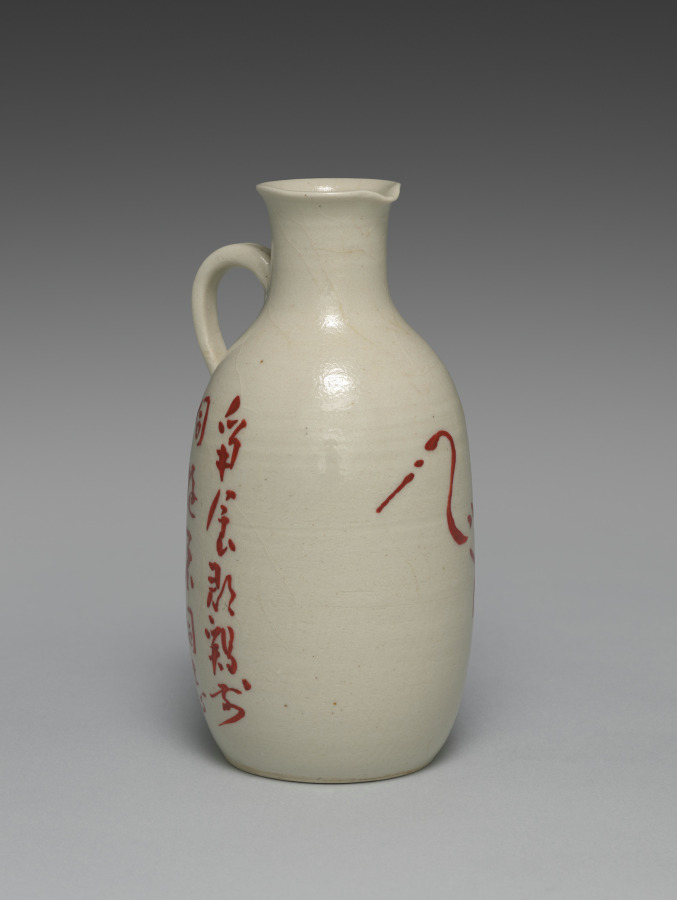
One of a pair of sake flasks; porcelain with overglaze color enamel · Japan, Meiji period (1868–1912) · Overall: 13.9 cm (5 1/2 in.) · Japanese Art
This flask has a crane with a leg raised, while the other flask of this pair has stencil-like paintings of three turtles—a young one with its parents. Cranes and turtles are well-recognized symbols of longevity in East Asia, with the turtle said to live for ten thousand years and the crane for one thousand. Each flask also has a poem on the back, one in Chinese and the other in Japanese. The Chinese poem on this crane flask is two nonconsecutive five-character lines from a poem called “Crane Feelings” by the famous Tang dynasty poet Bai Juyi (772–846). One character in one of the lines has been altered. This creative poetic sampling results in a verse reading zheng shi qun ji qian, tong you zhe tong zhi 爭食羣雞前,同遊者同志. It could perhaps be translated, “before the flock of chickens competing for food, those traveling together have the same ambitions.”
View the original at Cleveland Museum of Art →Article 1 states the aim as a beautiful and dignified national land, and it covers not only cities but farming, mountain and fishing villages. Inside a landscape planning area, Article 16 requires advance notification of new building, extension, rebuilding, relocation, and any repair or alteration that changes the exterior. Landscape Districts go further and impose direct restrictions on the form and design of buildings.
The cool part. Read Article 16 to the end of the sentence. A change of colour is listed alongside new construction as an act you must notify. Repainting your building is, in law, the same category of event as putting up a new one. This is the machinery behind the muted shopfronts of Kyoto. The brown coffee-shop sign is not a marketing choice, it is compliance.
Verify at e-Gov 法令検索 →Use it Take the ratio, not the picture. It sets a page better than a grid does.
Description source: museum curator text, translated — not generated