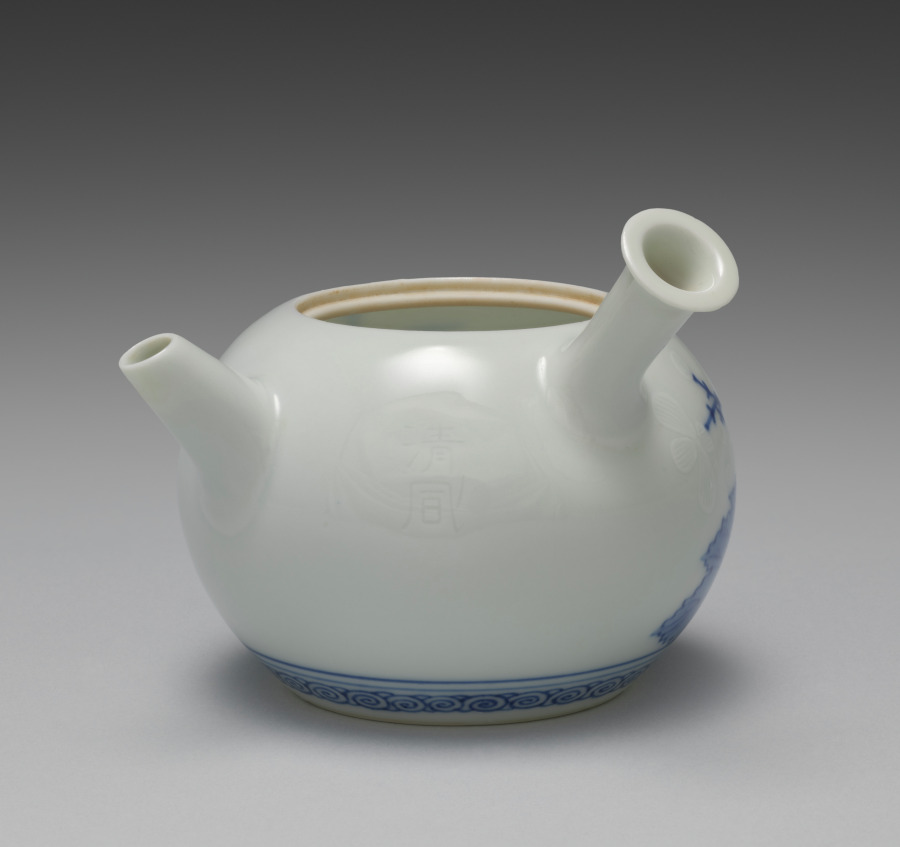
This teapot has complex surface treatment: a design of begonias in modulated underglaze blue for the leaves and stems as well as thick overglaze white with incised lines to define the petals, plus small areas of underglaze yellow at their low-relief centers. A band of underglaze blue gives further definition to the lid’s handle, and the area just above the base has a double band of blue above a row of snail-shell curls. Unlike many other teapots, which have marks on their bases, this one has “Seifu” incised into one of its sides in relatively large characters. It is the side that would face the host if the teapot were held by the handle with the right hand, which would be the expectation.
View the original at Cleveland Museum of Art →Article 1 gives three grounds for regulating a sign: forming good landscape, maintaining scenic character, and preventing danger to the public. Article 3 then lets a prefecture prohibit outdoor advertising outright, by ordinance, in named categories of place.
The cool part. Read the list in Article 3 and it stops being an advertising law. The places where signage can be banned include landscape districts, scenic districts, preservation districts for groups of traditional buildings, the surroundings of designated Important Cultural Properties, and historic sites, places of scenic beauty and natural monuments. The statute protects the view by removing the sentences written across it.
Verify at e-Gov 法令検索 →Use it A motif small enough to blind-deboss, which is where restraint actually shows.
Description source: museum curator text — not generated