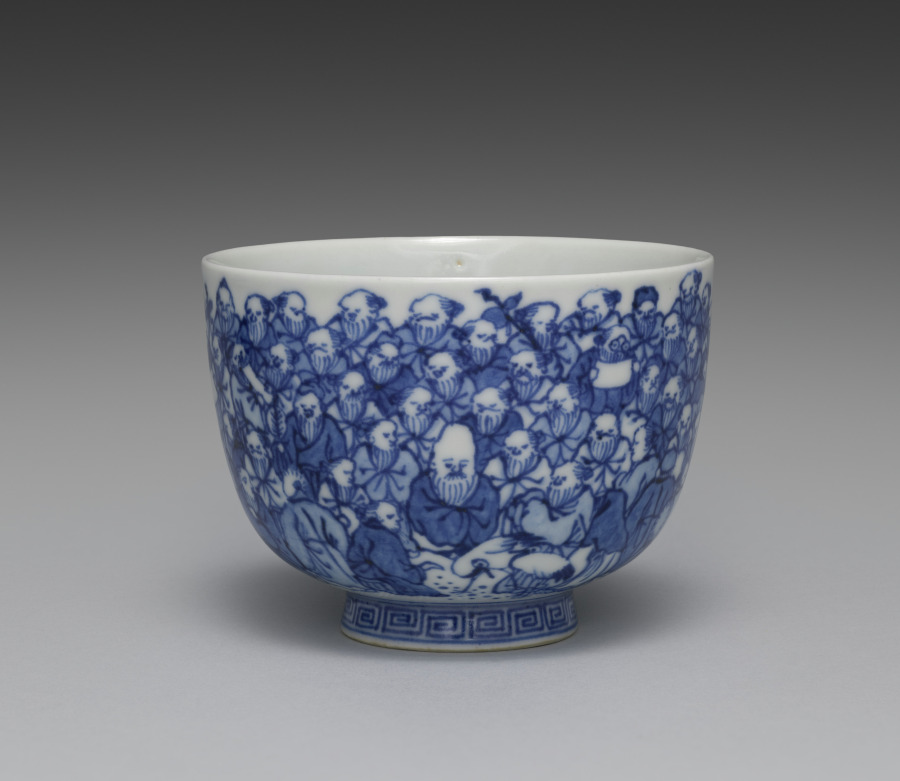
Each of these five teacups has a painting of identical design in underglaze blue, but as the tiny figures are drawn entirely by hand, each cup has its own personality. The theme of the sencha cups is an assembly of sages or immortals, literally “a hundred venerable [people]” (hyakurō). The myriad figures crowd the scene in groups. The god of longevity, with his tall forehead, sits with his cranes, having flown in from Mt. Penglai on the Isle of the Immortals. Seven long-bearded sages sit around a stone table, chatting and drinking; one is seated on an enormous gourd. Of course, there is a stack of books on the table, and elsewhere, scrolls are being written upon or read—in one case held very close by a sage who is wearing glasses. The design was enormously popular in ceramics made for those engaged in literati culture.
View the original at Cleveland Museum of Art →A national statute written for one city. Article 1 recites the beauty of Kyoto and its historically, culturally and artistically important position in the world, and gives two purposes: to raise international culture and serve the ideal of permanent world peace, and to contribute to the economic recovery of Japan. It was passed five years after the war ended.
The cool part. Article 3 lets Kyoto designate culture tourism preservation districts and, by ordinance, prohibit building, rebuilding, removal, changes to the shape of the land and the cutting of bamboo, trees and stone, with compensation for ordinary loss. Then Article 4 does something statutes almost never do. It places a duty on the mayor personally: in the spirit of local autonomy, and with the cooperation of residents, the mayor must engage in ceaseless activity to complete the city. Nara received its own Act, number 250, the day before.
Verify at e-Gov 法令検索 →Use it Two-colour foil on uncoated stock gets you most of this at production cost.
Description source: museum curator text — not generated