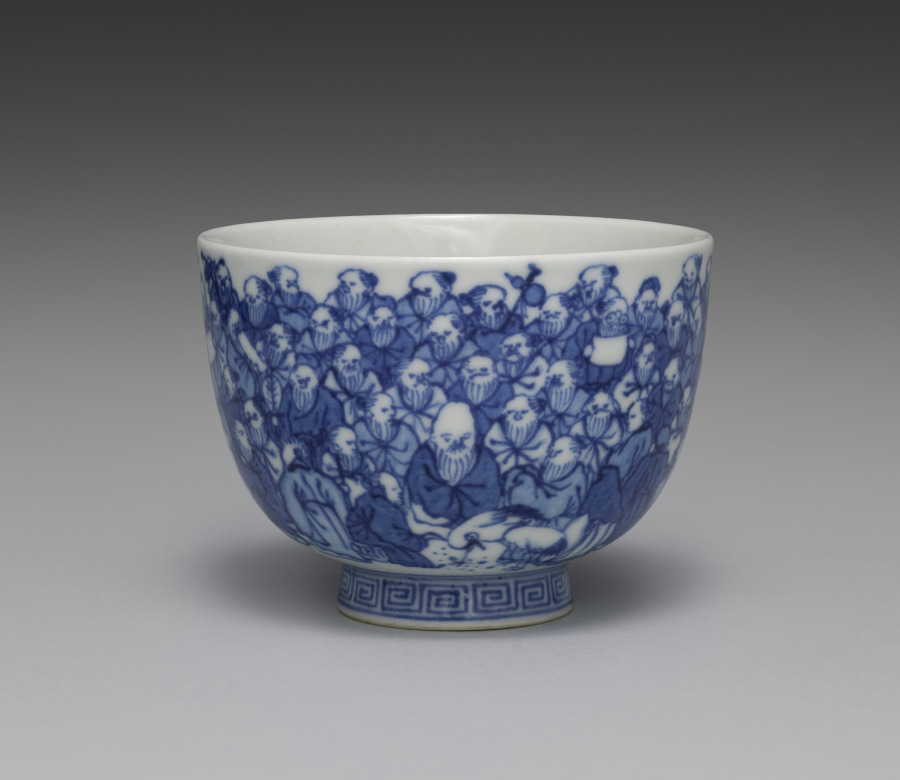
Each of these five teacups has a painting of identical design in underglaze blue, but as the tiny figures are drawn entirely by hand, each cup has its own personality. The theme of the sencha cups is an assembly of sages or immortals, literally “a hundred venerable [people]” (hyakurō). The myriad figures crowd the scene in groups. The god of longevity, with his tall forehead, sits with his cranes, having flown in from Mt. Penglai on the Isle of the Immortals. Seven long-bearded sages sit around a stone table, chatting and drinking; one is seated on an enormous gourd. Of course, there is a stack of books on the table, and elsewhere, scrolls are being written upon or read—in one case held very close by a sage who is wearing glasses. The design was enormously popular in ceramics made for those engaged in literati culture.
View the original at Cleveland Museum of Art →Article 1 describes the Ainu as the indigenous people of the northern part of the Japanese archipelago and of Hokkaido in particular, and cites international circumstances concerning indigenous peoples as a reason for acting. It requires the government to set a basic policy, and lets municipalities draw up regional plans for approval by the Prime Minister.
The cool part. The definition in Article 2 is the part to sit with. Ainu culture means the Ainu language, and the ways of living, music, dance, crafts and other cultural products inherited among the Ainu, and cultural products developed from these. That final clause refuses to freeze the culture at a date, and treats what is made next as equally the thing being protected. The Act then reaches into trademark law, reducing or waiving registration fees for regional collective trademarks used by approved projects.
Verify at e-Gov 法令検索 →Use it A motif small enough to blind-deboss, which is where restraint actually shows.
Description source: museum curator text — not generated