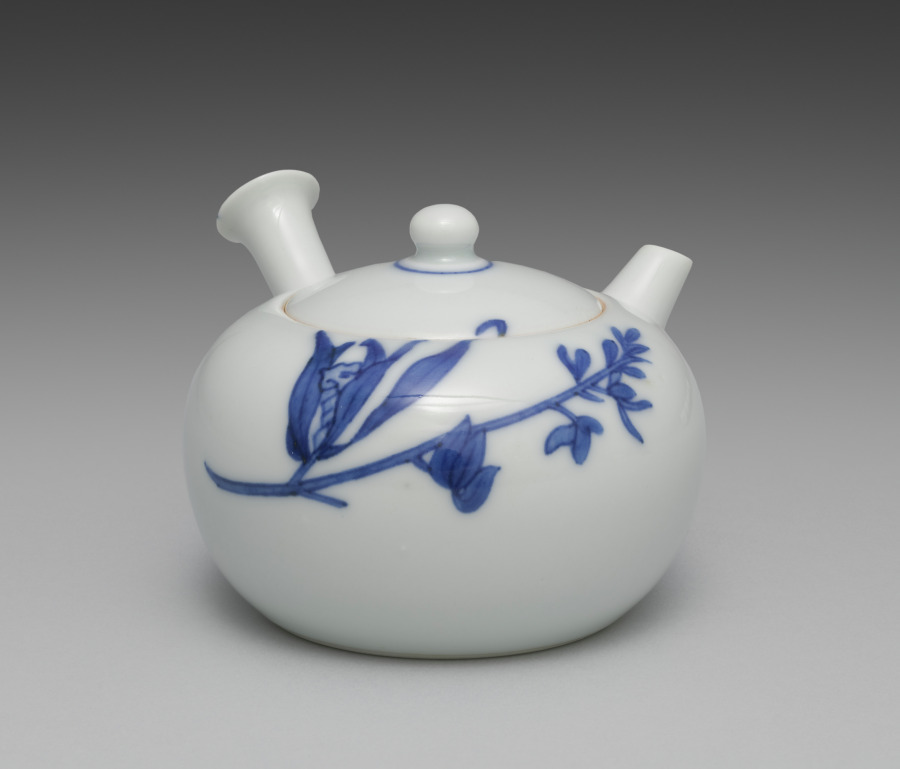
Although the teapot here is stored in a separate box from the five cups, these six pieces may once have been part of a tea set that included other tools such as a water cooler. The teacups have orchid flowers on both sides in underglaze blue, as well as a blue band inside the footring. The teapot has the same design and a blue band painted around the bottom of the lid’s knob. The cups’ long wood storage box is stamped on the exterior, over the lid and base, with a small red seal reading “Satō.” The same seal appears on five small squares of yellow textile, one placed in the bottom of each compartment in the teacup storage box. These are additional to the customary yellow cloths stamped with a “Seifu” seal. Interestingly, four of the Seifū cloths are stamped with an ovoid seal, while the remaining cloth, which is a slightly lighter color, has an unusual seal that is not quite gourd-shaped and with the fū of Seifū in a stylized, unrecognizable form. The teapot has its own box with a Satō seal and is wrapped with an orange textile stamped with the same unusual Seifū seal. A set with a very similar surface design is in the Brooklyn Museum. The Brooklyn set has a water cooler and a small pitcher, in addition to the teapot and cups, and all are in a single storage box.
View the original at Cleveland Museum of Art →A craft cannot call itself traditional by taste or reputation. Article 2 sets five conditions, all of which must hold: it is used mainly in daily life, the main part of its making is by hand, it is made by traditional techniques, it is made chiefly from materials traditionally used, and a not-small number of people in a defined area still make it. The designation names the techniques, the materials and the region.
The cool part. Two conditions do quiet work. The first is daily use, so a technique kept alive only for display does not qualify. The fifth is the number of makers: the law will not protect a single surviving genius, because one person is a biography and not an industry. And because the region is written into the designation, the craft is legally attached to a place and cannot move.
Verify at e-Gov 法令検索 →Use it Take the ratio, not the picture. It sets a page better than a grid does.
Description source: museum curator text — not generated