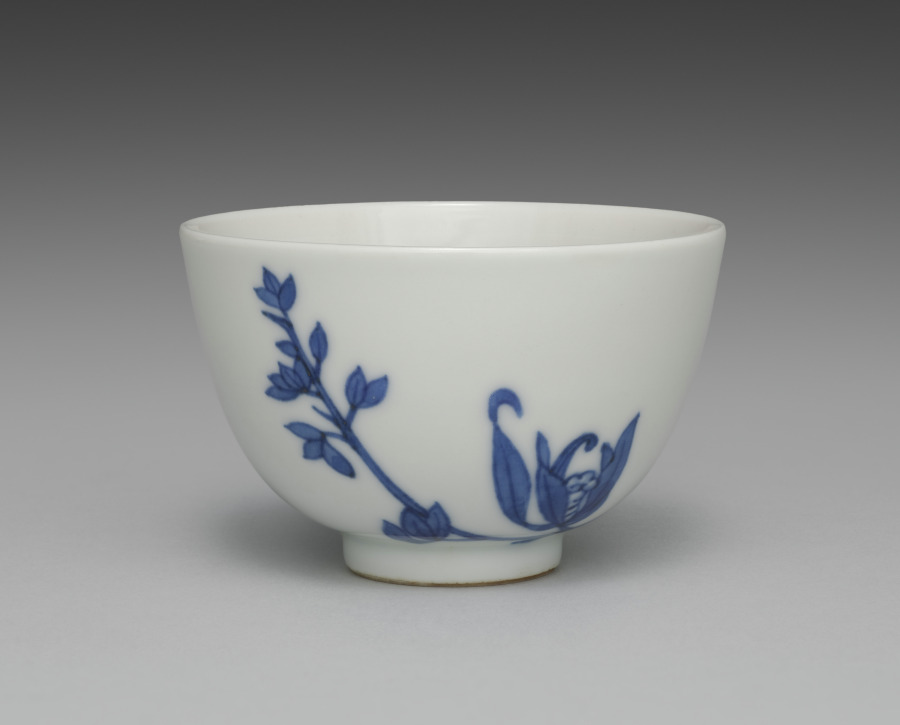
Although the teapot here is stored in a separate box from the five cups, these six pieces may once have been part of a tea set that included other tools such as a water cooler. The teacups have orchid flowers on both sides in underglaze blue, as well as a blue band inside the footring. The teapot has the same design and a blue band painted around the bottom of the lid’s knob. The cups’ long wood storage box is stamped on the exterior, over the lid and base, with a small red seal reading “Satō.” The same seal appears on five small squares of yellow textile, one placed in the bottom of each compartment in the teacup storage box. These are additional to the customary yellow cloths stamped with a “Seifu” seal. Interestingly, four of the Seifū cloths are stamped with an ovoid seal, while the remaining cloth, which is a slightly lighter color, has an unusual seal that is not quite gourd-shaped and with the fū of Seifū in a stylized, unrecognizable form. The teapot has its own box with a Satō seal and is wrapped with an orange textile stamped with the same unusual Seifū seal. A set with a very similar surface design is in the Brooklyn Museum. The Brooklyn set has a water cooler and a small pitcher, in addition to the teapot and cups, and all are in a single storage box.
View the original at Cleveland Museum of Art →A weapons statute that contains the most important art registry in the country. Article 2 defines a sword by measurement: a blade of fifteen centimetres or more for a sword, spear or naginata, five and a half for a dagger. Article 14 then carves out an exception. The prefectural board of education registers old firearms of value as art or antiques, and swords of value as art, on the basis of an appraisal by registration examiners appointed for their scholarly knowledge.
The cool part. A Japanese sword is lawful to own because it has been certified as art. Not because it was disarmed, not because it was licensed as a weapon. The judgement is made by the board of education, and Article 14 then requires the board to notify the prefectural public safety commission of what it has decided. The culture side rules, and the police are informed afterwards. Fail the appraisal and the same object becomes contraband.
Verify at e-Gov 法令検索 →Use it A motif small enough to blind-deboss, which is where restraint actually shows.
Description source: museum curator text — not generated