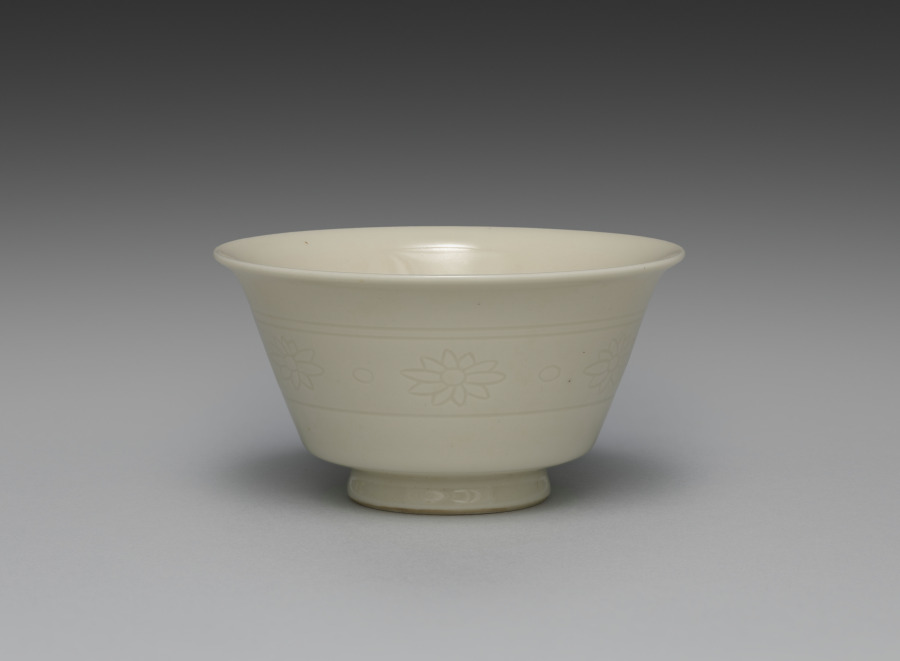
The five sencha teacups in this set are decorated with incised flowers and dots between a double band at the top and a single band at the bottom. They are in Yohei III’s creamy taihakuji body and glaze. In their motifs, they are quite similar to an incense burner by Yohei III (see CMA 2022.180), but the flowers are even more simple in design, with no open circle at the center. A label affixed to the side of the box refers to them as “sencha cups in emulation of Korean white [ware].” The reference to Korean ware indicates that even though Yohei was more directly inspired by Qing dynasty wares from the Dehua kilns in Fujian Province in developing his porcelain clay and glaze for works such as these, the general understanding of the continental models still placed them, at least in terms of color, among pieces broadly associated in Japan with Korean white wares. The delicate cups are thinly potted, so they have a highly desirable translucency.
View the original at Cleveland Museum of Art →A craft cannot call itself traditional by taste or reputation. Article 2 sets five conditions, all of which must hold: it is used mainly in daily life, the main part of its making is by hand, it is made by traditional techniques, it is made chiefly from materials traditionally used, and a not-small number of people in a defined area still make it. The designation names the techniques, the materials and the region.
The cool part. Two conditions do quiet work. The first is daily use, so a technique kept alive only for display does not qualify. The fifth is the number of makers: the law will not protect a single surviving genius, because one person is a biography and not an industry. And because the region is written into the designation, the craft is legally attached to a place and cannot move.
Verify at e-Gov 法令検索 →Use it Take the ratio, not the picture. It sets a page better than a grid does.
Description source: museum curator text — not generated