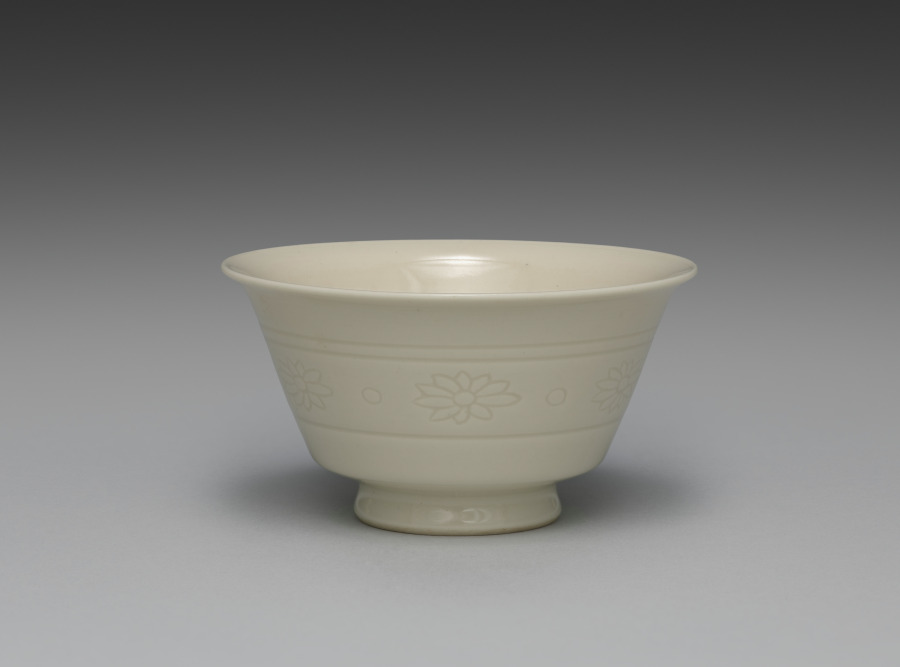
The five sencha teacups in this set are decorated with incised flowers and dots between a double band at the top and a single band at the bottom. They are in Yohei III’s creamy taihakuji body and glaze. In their motifs, they are quite similar to an incense burner by Yohei III (see CMA 2022.180), but the flowers are even more simple in design, with no open circle at the center. A label affixed to the side of the box refers to them as “sencha cups in emulation of Korean white [ware].” The reference to Korean ware indicates that even though Yohei was more directly inspired by Qing-dynasty wares from the Dehua kilns in Fujian Province in developing his porcelain clay and glaze for works such as these, the general understanding of the continental models still placed them, at least in terms of color, among pieces broadly associated in Japan with Korean white wares. The delicate cups are thinly potted, so they have a highly desirable translucency.
View the original at Cleveland Museum of Art →Article 1 gives three grounds for regulating a sign: forming good landscape, maintaining scenic character, and preventing danger to the public. Article 3 then lets a prefecture prohibit outdoor advertising outright, by ordinance, in named categories of place.
The cool part. Read the list in Article 3 and it stops being an advertising law. The places where signage can be banned include landscape districts, scenic districts, preservation districts for groups of traditional buildings, the surroundings of designated Important Cultural Properties, and historic sites, places of scenic beauty and natural monuments. The statute protects the view by removing the sentences written across it.
Verify at e-Gov 法令検索 →Use it A motif small enough to blind-deboss, which is where restraint actually shows.
Description source: museum curator text — not generated