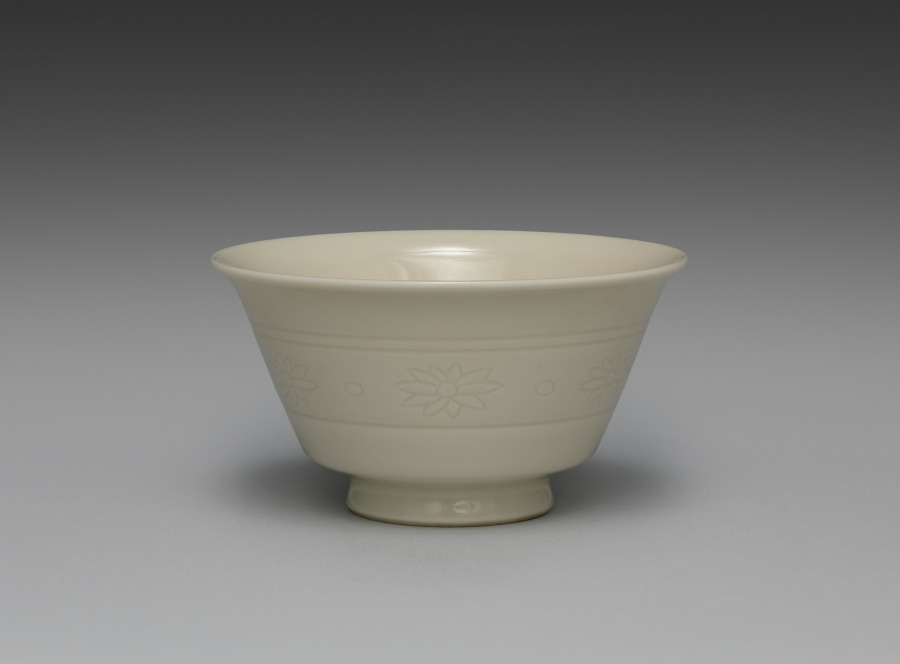
The five sencha teacups in this set are decorated with incised flowers and dots between a double band at the top and a single band at the bottom. They are in Yohei III’s creamy taihakuji body and glaze. In their motifs, they are quite similar to an incense burner by Yohei III (see CMA 2022.180), but the flowers are even more simple in design, with no open circle at the center. A label affixed to the side of the box refers to them as “sencha cups in emulation of Korean white [ware].” The reference to Korean ware indicates that even though Yohei was more directly inspired by Qing-dynasty wares from the Dehua kilns in Fujian Province in developing his porcelain clay and glaze for works such as these, the general understanding of the continental models still placed them, at least in terms of color, among pieces broadly associated in Japan with Korean white wares. The delicate cups are thinly potted, so they have a highly desirable translucency.
View the original at Cleveland Museum of Art →A national statute written for one city. Article 1 recites the beauty of Kyoto and its historically, culturally and artistically important position in the world, and gives two purposes: to raise international culture and serve the ideal of permanent world peace, and to contribute to the economic recovery of Japan. It was passed five years after the war ended.
The cool part. Article 3 lets Kyoto designate culture tourism preservation districts and, by ordinance, prohibit building, rebuilding, removal, changes to the shape of the land and the cutting of bamboo, trees and stone, with compensation for ordinary loss. Then Article 4 does something statutes almost never do. It places a duty on the mayor personally: in the spirit of local autonomy, and with the cooperation of residents, the mayor must engage in ceaseless activity to complete the city. Nara received its own Act, number 250, the day before.
Verify at e-Gov 法令検索 →Use it Two-colour foil on uncoated stock gets you most of this at production cost.
Description source: museum curator text — not generated