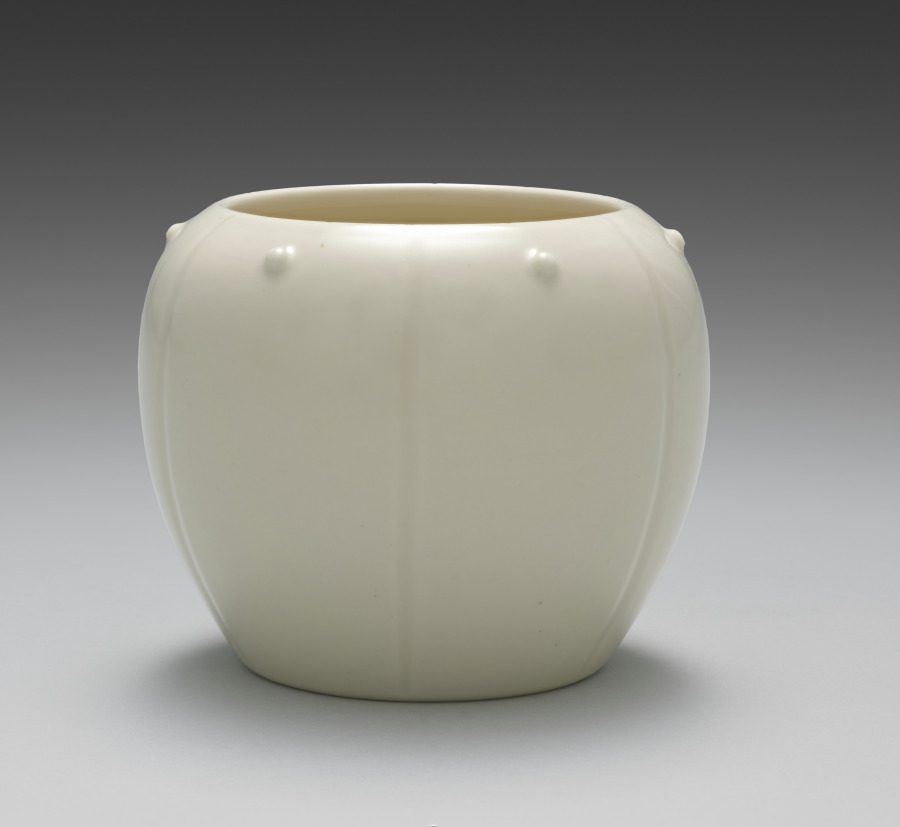
The box lid for these six-lobed lit charcoal and ash containers, or hiire, identifies them as kōhakuji, another of Yohei III’s translucent cream colors over ivory clay bodies. One might translate the name as “lustrous pearl[–glazed ivory] porcelain.” A hiire was filled with ash with burnt coals at the center so that embers and tobacco ash could be discarded safely during a gathering. Each of the lobes on the containers has a round protrusion set below the rim. The studlike pattern is called ruiza. The term is also used to describe the pattern that rings the shoulder of some flower vases or metal kettles used in chanoyu.
View the original at Cleveland Museum of Art →Article 2 defines a museum as an institution that collects, keeps and displays materials on history, art, folklore, industry and natural science for public use, carries out research on them, and which has been registered under Chapter 2 of this Act. The registration is not decorative. In law, an unregistered collection open to the public is not a museum.
The cool part. The definition of keeping is given as including raising. That single parenthesis is why a zoo, an aquarium and a botanical garden sit inside museum law in Japan: the collection is allowed to be alive. Article 1 also grounds the statute in the Social Education Act and the Basic Act on Culture and the Arts, which places museums in education first and culture second.
Verify at e-Gov 法令検索 →Use it Palette for a single-colour run: one ink, heavy stock, nothing else on the sheet.
Description source: museum curator text — not generated