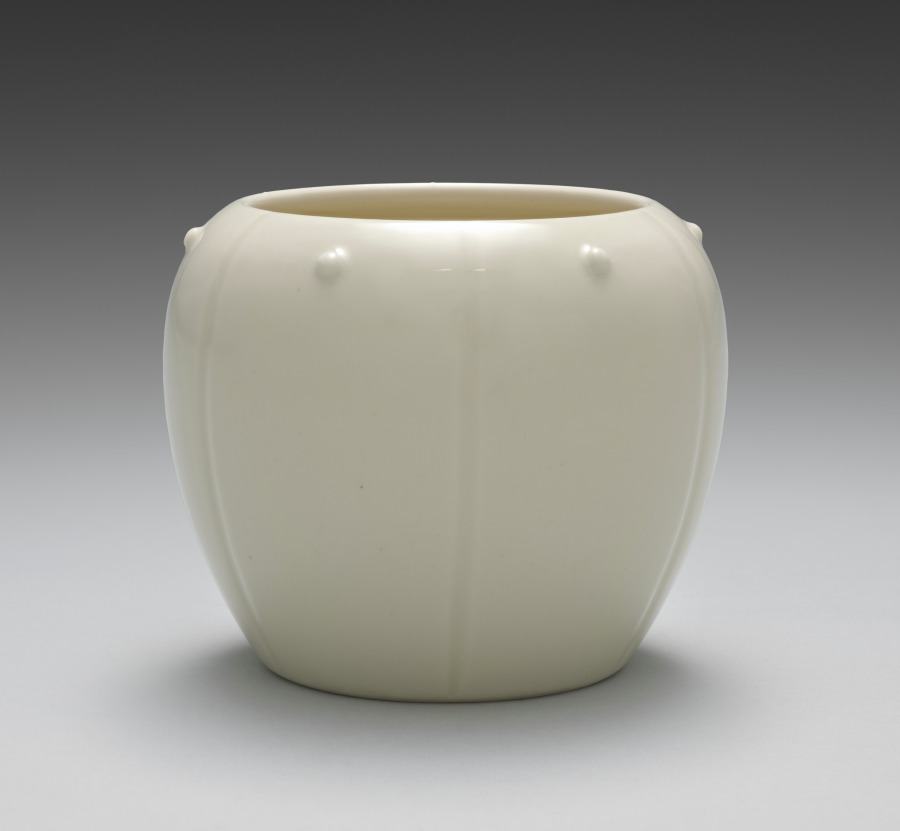
The box lid for these six-lobed lit charcoal and ash containers, or hiire, identifies them as kōhakuji, another of Yohei III’s translucent cream colors over ivory clay bodies. One might translate the name as “lustrous pearl[–glazed ivory] porcelain.” A hiire was filled with ash with burnt coals at the center so that embers and tobacco ash could be discarded safely during a gathering. Each of the lobes on the containers has a round protrusion set below the rim. The studlike pattern is called ruiza. The term is also used to describe the pattern that rings the shoulder of some flower vases or metal kettles used in chanoyu.
View the original at Cleveland Museum of Art →Japan implementing the 1970 UNESCO Convention. When a foreign state reports that cultural property has been stolen from an institution, the Ministry of Foreign Affairs notifies the education ministry, which designates the object as specified foreign cultural property, after consulting the trade ministry. Importing a designated object then requires approval under the foreign exchange and trade law.
The cool part. Article 6 quietly rewrites private law. Under the Civil Code a good-faith purchaser is normally secure against a recovery claim after two years. For designated stolen foreign cultural property, the victim may demand recovery from two years after the theft until ten years have passed. Buying in good faith does not settle the question for a decade, which is roughly how long it takes a stolen object to surface on a legitimate market.
Verify at e-Gov 法令検索 →Use it A motif small enough to blind-deboss, which is where restraint actually shows.
Description source: museum curator text — not generated