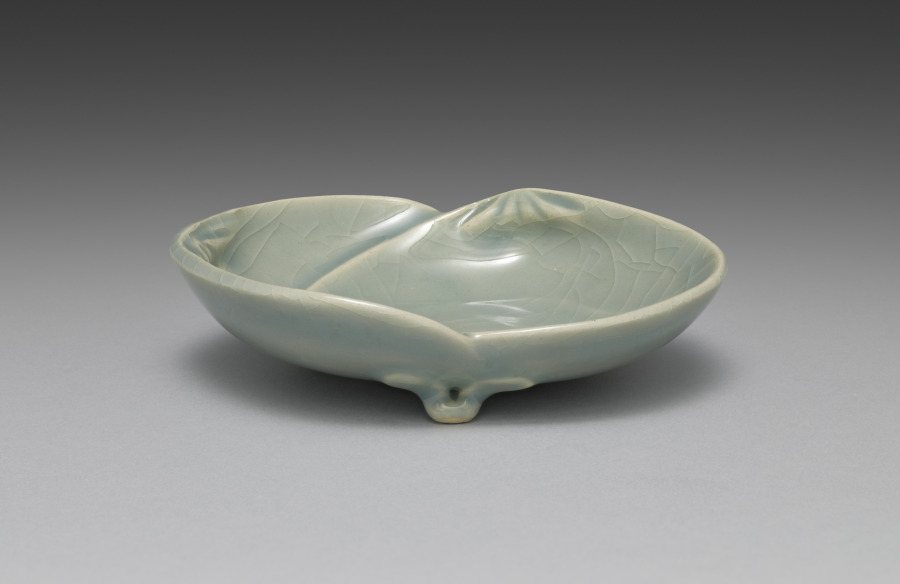
Yohei III’s main output for his sophisticated clientele was in the form of tea sets and dining sets. He created a range of dishes in green glazes. He often produced in pairs, sets of five, or sets of ten. The set of five dishes with a more complex form is described as having a “water-colored glaze” (mizuiroyū). These are shaped like clam half shells, a reference to a game in which shell halves painted with narrative scenes or a variety of motifs must be matched back together by the players. The dishes have molded details to articulate the shell forms, and the crackling across each shell adds another dimension to the surface. Each dish is set on three small feet, formed by a pinched piece of clay and attached to an unglazed area on the underside of the dish. Curiously, while four of the dishes are stamped with the artist’s mark, one has instead a signature carved into the base.
View the original at Cleveland Museum of Art →Article 1 states the aim as a beautiful and dignified national land, and it covers not only cities but farming, mountain and fishing villages. Inside a landscape planning area, Article 16 requires advance notification of new building, extension, rebuilding, relocation, and any repair or alteration that changes the exterior. Landscape Districts go further and impose direct restrictions on the form and design of buildings.
The cool part. Read Article 16 to the end of the sentence. A change of colour is listed alongside new construction as an act you must notify. Repainting your building is, in law, the same category of event as putting up a new one. This is the machinery behind the muted shopfronts of Kyoto. The brown coffee-shop sign is not a marketing choice, it is compliance.
Verify at e-Gov 法令検索 →Use it A motif small enough to blind-deboss, which is where restraint actually shows.
Description source: museum curator text — not generated