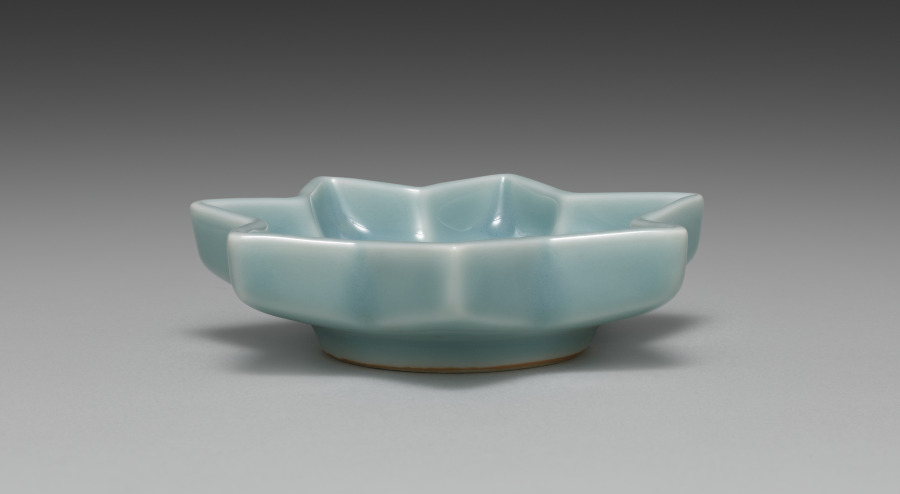
These maple leaf–shaped saucers, like Yohei III's five shell saucers CMA 2022.188, have a long, horizontal box with a separate compartment for each piece. Now a set of five, these dishes were originally a set of ten, stored in two boxes of five each. From their housings, which accommodate differing numbers of objects, one can hypothesize that while some items created by the Seifu studio were intended to be acquired in larger sets, and thus were perhaps made to order, others, like these, may have been items to be purchased of the shelf in set quantities that allowed clients flexibility in scale. The box for these five saucers describes them as “heavenly blue[–glazed] porcelain” (tenseiji). The veins of the leaves are slightly raised in the clay so that the glaze pools around them and they stand out as white where the glaze thins. There are longer lines at the points of the leaves and shorter ones following the wall of each indentation so that the design has both a horizontal and a subtle vertical dimension.
View the original at Cleveland Museum of Art →Article 1 states the purpose plainly: prevent trade in stolen goods, find them quickly, and speed the recovery of victims. Article 2 then defines a used article to include, in the same breath, art objects held for appreciation. Dealing in them requires a licence.
The cool part. Article 16 requires a dealer to record every transaction: the date, the item and quantity, its distinguishing features, and the address, name, occupation and age of the other party. Article 15 requires that a dealer who suspects an item is stolen report it to a police officer immediately. So the antique trade runs on a register the police may read, and a painting becomes a second-hand article the moment it has been used once.
Verify at e-Gov 法令検索 →Use it Take the ratio, not the picture. It sets a page better than a grid does.
Description source: museum curator text — not generated