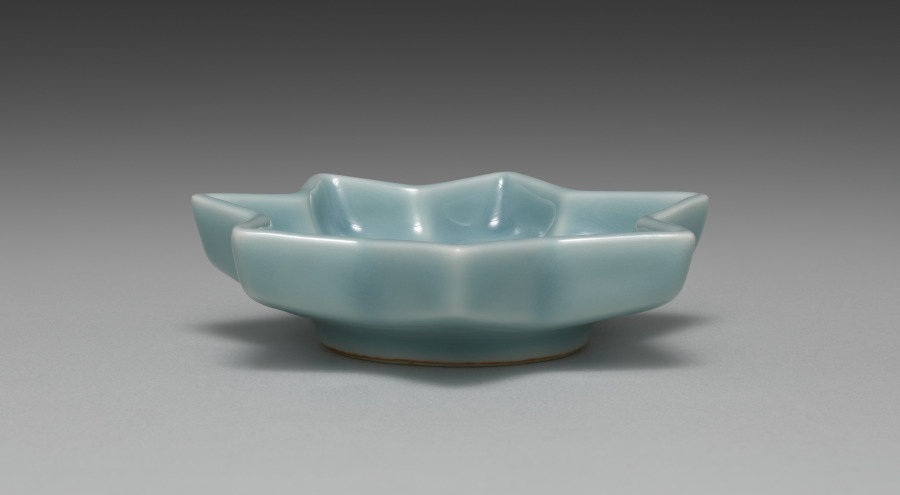
These maple leaf–shaped saucers, like Yohei III's five shell saucers CMA 2022.188, have a long, horizontal box with a separate compartment for each piece. Now a set of five, these dishes were originally a set of ten, stored in two boxes of five each. From their housings, which accommodate differing numbers of objects, one can hypothesize that while some items created by the Seifu studio were intended to be acquired in larger sets, and thus were perhaps made to order, others, like these, may have been items to be purchased of the shelf in set quantities that allowed clients flexibility in scale. The box for these five saucers describes them as “heavenly blue[–glazed] porcelain” (tenseiji). The veins of the leaves are slightly raised in the clay so that the glaze pools around them and they stand out as white where the glaze thins. There are longer lines at the points of the leaves and shorter ones following the wall of each indentation so that the design has both a horizontal and a subtle vertical dimension.
View the original at Cleveland Museum of Art →A statute built to coax privately held work onto public walls. An owner registers a piece with the Commissioner for Cultural Affairs, then contracts with a museum to display it. Article 2 defines a work of art broadly, as paintings, sculpture, crafts and other tangible cultural products that are movable, which is the legal way of saying anything you could carry out of the house.
The cool part. The terms are the interesting part. Article 2 requires the public display contract to run for five years or more, and to contain a clause stating that the parties may not give notice of cancellation. You cannot lend a masterpiece for the tax treatment and then reclaim it when the market turns. Japan concluded the barrier to seeing art was never storage. It was ownership, and the fix was a contract you cannot walk out of.
Verify at e-Gov 法令検索 →Use it Take the ratio, not the picture. It sets a page better than a grid does.
Description source: museum curator text — not generated