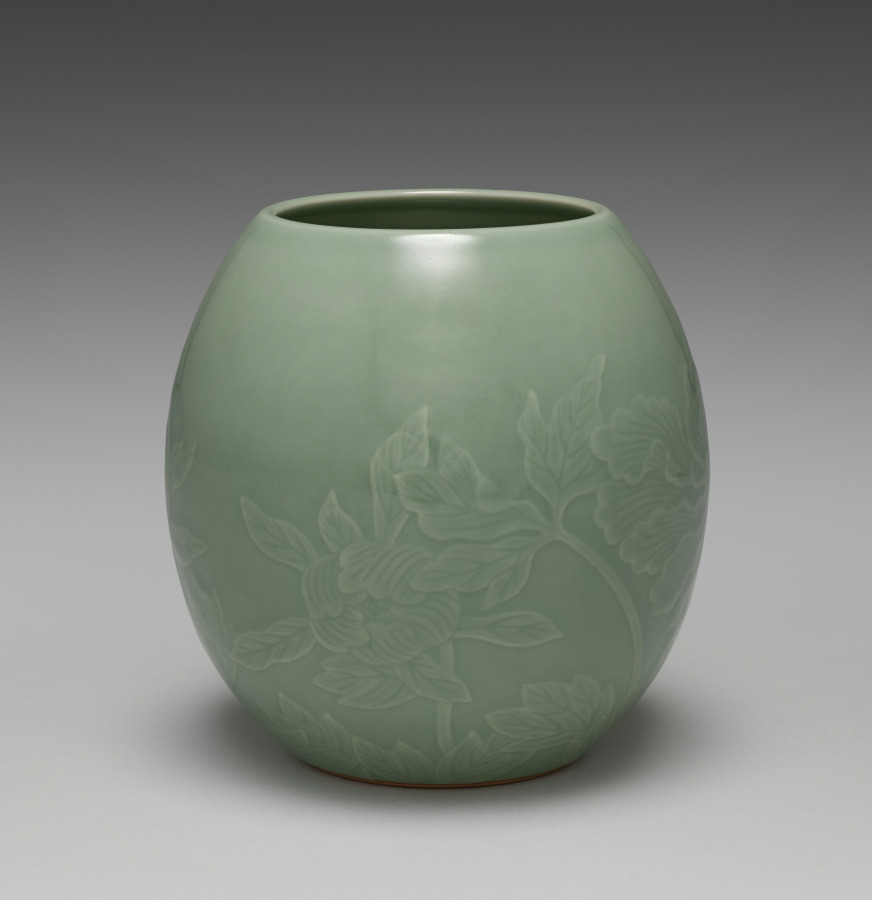
This ceramic is an especially accomplished example of Yohei III’s combination of an all-over translucent colored glaze with molded and carved designs. It features the peony as its primary motif. The water container, or mizusashi, has a green glaze, and its design takes into consideration the rounded shape and the seated position of the host and guests. It begins low on the body with a flower just beginning to open and continues with another flower a bit higher up, with its petals fully extended and beginning to open outward. It finishes with a flower in full bloom, petals and leaves unfurled and spread outward from the center, now occupying almost the entire surface. The water container once belonged to the Hosokawa family, whose go-between corresponded with Yohei IV about the piece. Yohei IV thanked them for their payment and requested that despite his father’s death in the previous year, they continue to favor the studio with their orders. The letter and its envelope, as well as an auction tag, remain with the object.
View the original at Cleveland Museum of Art →Unusually for a Japanese statute it opens with a preamble, which states that finding joy in creating culture and living among it is an unchanging wish of people, and that culture contributes to world peace. Article 2 then sets the principles: the autonomy of those who make culture must be fully respected, and their creativity, standing and capacity considered.
The cool part. Article 2, paragraph 3 is the line worth reading twice. It says that creating and receiving culture is a right people are born with, and requires an environment in which citizens can appreciate, participate and create regardless of age, disability, economic situation, or the area they live in. Four barriers named in statute, one of which is your postcode. It puts the arts in the same grammatical register as infrastructure. Not a subsidy argued for each year, a standing obligation.
Verify at e-Gov 法令検索 →Use it A motif small enough to blind-deboss, which is where restraint actually shows.
Description source: museum curator text — not generated