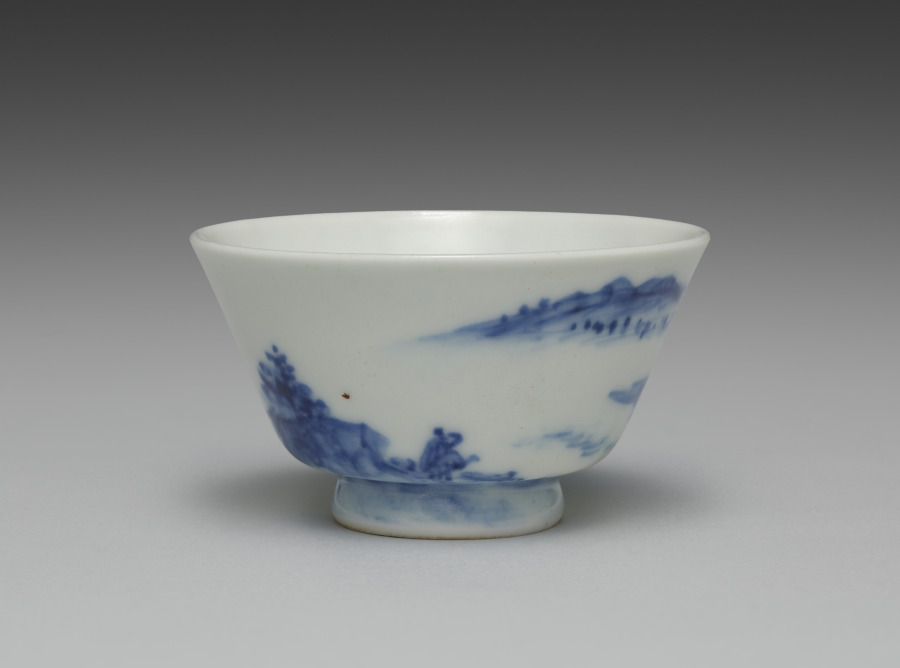
Originally from a set of 12, each of these 11 sencha teacups has a different landscape wrapped around the body, giving individual cups their own engaging narrative. These paintings are comfortingly familiar in their formulaic qualities, known to any casual fan of ink painting; they are also enjoyable in the way the narratives are revealed as one manipulates the cups. They would be perfect as conversation pieces for a tea gathering. Four of the cups focus on travelers approaching residences. Two have a person crossing a bridge as their central motif: one man has a backpack, and the other, a cloth-wrapped bundle hanging from a pole slung over his shoulder. Another cup depicts a pair of friends gathered together on rock platforms. A single cup shows a man carrying a furled banner toward a pavilion. The remaining three cups feature people riding in boats: two have literati passengers, and the third is occupied by a fisherman. Seifu Yohei IV’s training as a painter with Tanomura Shosai (1847–1909), an adoptive son of Tanomura Chokunyu, his father’s painting teacher, is evident in the details of the tiny worlds created on the cups.
View the original at Cleveland Museum of Art →A statute built to coax privately held work onto public walls. An owner registers a piece with the Commissioner for Cultural Affairs, then contracts with a museum to display it. Article 2 defines a work of art broadly, as paintings, sculpture, crafts and other tangible cultural products that are movable, which is the legal way of saying anything you could carry out of the house.
The cool part. The terms are the interesting part. Article 2 requires the public display contract to run for five years or more, and to contain a clause stating that the parties may not give notice of cancellation. You cannot lend a masterpiece for the tax treatment and then reclaim it when the market turns. Japan concluded the barrier to seeing art was never storage. It was ownership, and the fix was a contract you cannot walk out of.
Verify at e-Gov 法令検索 →Use it Take the ratio, not the picture. It sets a page better than a grid does.
Description source: museum curator text — not generated