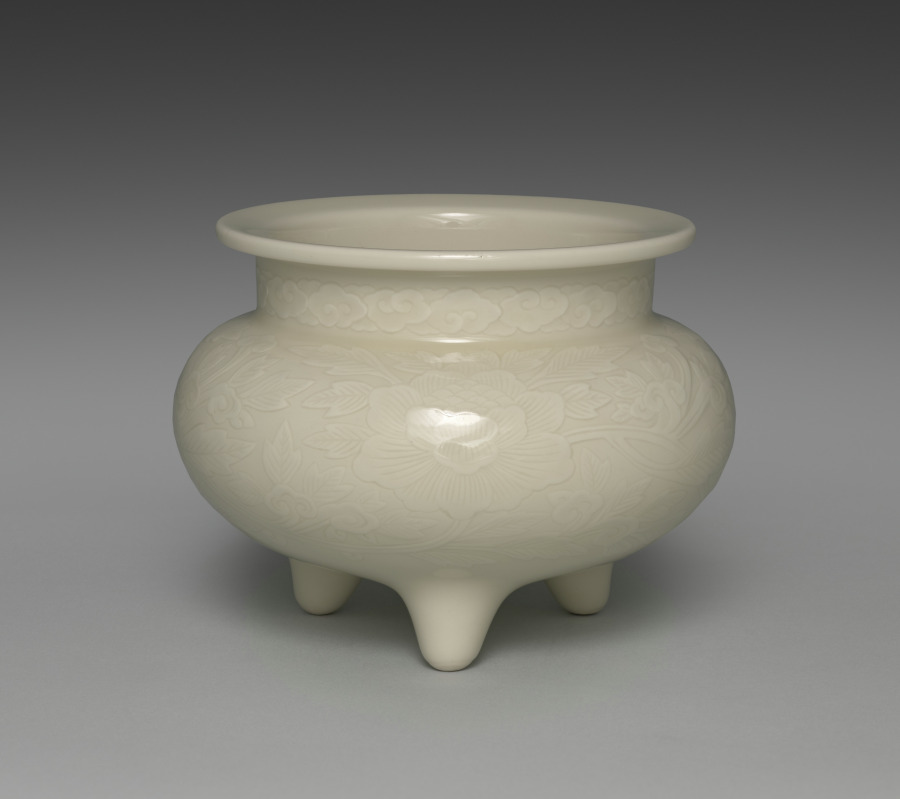
Yohei IV’s incense burner has a scrolling floral pattern of peonies and nyoi staff-head forms around the body and a band of clouds around the collar. These are done in low relief, with incised lines marking the details in the flower petals and leaves. The silver lid has a proliferation of flowers, including lily, peony, and a variety of chrysanthemums. The box lid identifies the subtle pink over an ivory body as “dawn’s light[–glazed] porcelain” (shokōji). After he became an Artist of the Imperial Household, Yohei III created a number of glaze and clay combinations with what would have been considered Japan-focused names to be in alignment with his position as an artist representing the nation. Among them was a glaze called “dawn’s light pale [pink] color” (akebonoiro tansai), which he invented in 1895. It is possible that this incense burner is an example with this glaze, despite the slightly different name given on the box. While the name alludes to the Land of the Rising Sun, an epithet for Japan, the burner’s motifs remain very much drawn from the Chinese repertoire.
View the original at Cleveland Museum of Art →Article 2 defines a museum as an institution that collects, keeps and displays materials on history, art, folklore, industry and natural science for public use, carries out research on them, and which has been registered under Chapter 2 of this Act. The registration is not decorative. In law, an unregistered collection open to the public is not a museum.
The cool part. The definition of keeping is given as including raising. That single parenthesis is why a zoo, an aquarium and a botanical garden sit inside museum law in Japan: the collection is allowed to be alive. Article 1 also grounds the statute in the Social Education Act and the Basic Act on Culture and the Arts, which places museums in education first and culture second.
Verify at e-Gov 法令検索 →Use it Two-colour foil on uncoated stock gets you most of this at production cost.
Description source: museum curator text — not generated