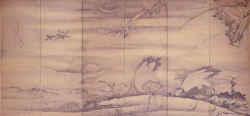
Once upon a time, Sasaki White was born in Kyoto as a merchant's child. In 1743 (Kanpō 3), he lost his father, followed by his mother three years later. After that, he established himself in the art world, but the details of how he did so are not clear. Around 1758-59 (Hōreki 8-9) and 1764 (Meiwa Gen) at least twice, he traveled to the Ise region (present-day Mie Prefecture), leaving behind numerous innovative works and anecdotes in this place. This painting depicts Lin Hejing, a literatus of the Northern Song Dynasty who loved cranes and plums, and lived as a hermit in a secluded temple by the West Lake. He was often depicted as an ideal scholar in art, but Sasaki White's portrayal of Lin Hejing shows an unusual, enigmatic expression. A large plum tree protrudes from the left side of the painting, with two cranes playing beneath it. The representation of the large tree is influenced by earlier works such as the "Four Seasons and Birds" by the temple Jōdo-ji's Enshō (by Daibutsu-en), and the "Old Kiyomizu-dera Screen Painting" by Banshō (by Kōetsu). Traditional themes and earlier representations were surpassed, and this innovative work was completed. It bears the inscription "Bosō Chūshū no Zushi," and is an important early work by Sasaki White. (Mitsuko Dōta, "Three-ree Prefectural Museum of Art Collection Selection," 2022)
曾我蕭白は京の商家に生まれた。1743(寛保3)年に父を、3年後に母を亡くしている。その後、画業で身を立てるに至った経緯は詳らかでないが、1758-59(宝暦8-9)頃と1764(明和元)年頃の少なくとも二度にわたり、伊勢地方(現・三重県)を遊歴し、この地に独創的な作品と逸話を多く遺した。 本作は、鶴と梅を愛し、西湖のほとり孤山に庵を結び隠遁した北宋の文人・林和靖を描いた屛風。理想の高士としてしばしば絵画化されたが、蕭白が描く林和靖は、隠棲に嫌気がさしたのか、うつろな表情をかくそうともしない。梅の巨木は画面を突き抜け左隻に枝を伸ばし、その下で二羽の鶴が遊ぶ。大樹の表現は、先行する大徳寺聚光院の狩野永徳《四季花鳥図襖》や彭城百川の《旧慈門院障壁画》に影響を受けたと指摘されている。 伝統的な画題や先行する表現を換骨奪胎し、斬新な作品に仕上げた本作は、「宝暦辰春之図」の款記を伴う。蕭白初期の基準作として重要な位置を占める作品である。 (道田美貴 『三重県立美術館 コレクション選』 2022年)
View the original at Japan Search →Article 1 sets a purpose larger than preservation: to preserve cultural properties AND to make use of them, contributing to the cultural advancement of the people and to the progress of world culture. Article 4 turns that outward. An owner must recognise the object as a precious national asset, preserve it for the public, and make it public as far as possible. Ownership here carries a duty to show.
The cool part. "Living National Treasure" appears nowhere in the statute. Article 71 requires that when an Important Intangible Cultural Property is designated, the minister must also certify its holder or holding group. Japan does not register the pot, it registers the potter. Article 96 is the one that reaches ordinary people: if you uncover a shell mound, a dwelling site or a tumulus, you must leave it exactly as it is and notify the Commissioner for Cultural Affairs without delay, and the Commissioner can freeze the ground for up to three months.
Verify at e-Gov 法令検索 →Use it Two-colour foil on uncoated stock gets you most of this at production cost.
Description source: museum curator text, translated — not generated