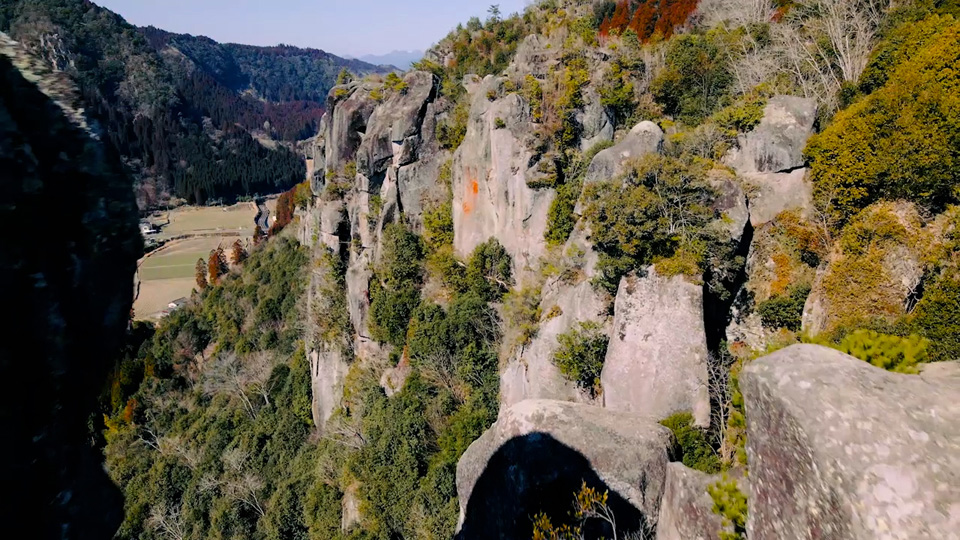
In the city of Nakatsu, Daito-ken, Okunoshima, there is a beautiful valley named "Yama-gawa." This extensive area, measuring about 32km north to south and 36km east to west, offers stunning views of vertical cliffs, pits, waterfalls, and natural stone bridges. For example, there is a series of holes in the riverbed formed by rotating stones called "Saru-bi Sen-sui," a "One-glance-eight-sceneries" valley with boulders encircling it, and a shallow gravel bar that stretches for 10km, all of which are part of the scenic beauty. The cycling road remnants and the old Arima Forest Engine Shed are among the railway heritage that can be discovered while enjoying the beautiful valley. Yama-gawa has also become a place of worship due to its mysterious landscape. Statues of Jizo, the guardian deity of children, have been enshrined in the cavities. The temple terrace of Rakan-ji features thousands of stone Rakan (Arhat) statues, creating a space that seems as if the statues are alive, practicing meditation. The oldest 500 Rakan statues in Japan, carved approximately 650 years ago, are a National Important Cultural Property. The allure of Yama-gawa lies in the fact that one can climb rocks, search for many hidden paths, and wear a chain around their waist.
大分県中津(なかつ)市と玖珠町には、「耶馬渓」という美しい渓谷があります。南北32km東西36kmの広い地域に、垂直に切り立った石の柱やほら穴、滝や巨石に天然の石橋など、驚きの光景が見られます。例えば、石が回転してできた穴が川底に連続する「猿飛千壺峡」、石柱群にぐるりと囲まれる「一目(ひとめ)八景(はっけい)」、10km続く一枚岩の浅瀬を歩ける「大谷渓谷」などです。サイクリングロードとなっている線路跡や「旧豊後森機関庫」などの鉄道遺産をたどりながら美しい渓谷を楽しめます。 耶馬渓は、その神秘的な地形から祈りの場所にもなってきました。あちこちの洞穴には石仏がおさめられました。岩壁に埋め込まれるように建てられた「羅漢寺(らかんじ)」一帯には、三千体をこえる石像が置かれており、石仏たちが生きて修行をしているような空間となっています。なかでも約650年前に彫られた日本最古の五百(ごひゃく)羅漢(らかん)石仏(せきぶつ)は国の重要文化財です。岩をはい、鎖をつたい、たくさんの探勝道を探検できるのが耶馬渓の魅力です。
View the original at Japan Search →It protects not the buildings but the setting that holds them. Article 2 defines historic landscape as land where structures and remains of historical significance form a single whole with the surrounding natural environment, which is the legal way of saying the hills, the approaches and the sightlines. The ancient capitals are Kyoto, Nara and Kamakura, plus any other municipality added by Cabinet Order. The Minister of Land, Infrastructure, Transport and Tourism designates a preservation area; city planning then carves a Special Preservation District over its core, and inside that district an owner needs permission from the prefectural governor to build, to fell timber, or to change the shape of the ground.
The cool part. It legislates the view, and then it pays for it. Article 10 requires the prefecture to compensate an owner who suffers loss because permission was refused. Article 12 goes further: where refusal seriously impairs the use of the land, the owner can require the prefecture to buy it, at market value. So the state does not merely tell you what the horizon behind a temple may look like. It agrees to purchase the land rather than let the skyline change. Two more things worth knowing. The prefecture must physically sign the district boundary, and a landowner may not obstruct the sign without just cause. And the ministry holding the pen is Transport, not Culture.
Verify at e-Gov 法令検索 →Use it The border is the idea. Use it as an edge treatment and leave the centre empty.
Description source: museum curator text, translated — not generated