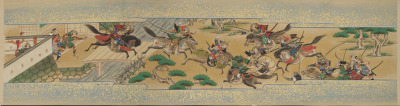
This is the second volume of a five-scroll series depicting the Onin War, which took place between the 12th and 13th years of the Onin era (around 1440-41). During the Onin War, the rulers of the Rokkaku and Ashikaga shogunal houses, Shogun Sh maru and Ujinao, disobeyed the shogunal court and took up arms against it (Battle of Onin). When the forces of the imperial court, under siege in Inshi, were met with fierce attacks, they were forced to attempt an escape from the city due to the depletion of their arrows.
永享12年~13年(1440~41)に起こった結城合戦を描いた5巻からなる絵巻物の2巻目です。結城氏朝が永享の乱で自害した鎌倉公方・足利持氏の遺児の春王丸・安王丸を奉じて、幕府に対して挙兵しました(結城合戦)。居城に籠もった結城勢に対して幕府による猛攻撃にあい、矢も尽きてしまったためやむなく城外への脱出を試みています。
View the original at Japan Search →Article 2 defines a museum as an institution that collects, keeps and displays materials on history, art, folklore, industry and natural science for public use, carries out research on them, and which has been registered under Chapter 2 of this Act. The registration is not decorative. In law, an unregistered collection open to the public is not a museum.
The cool part. The definition of keeping is given as including raising. That single parenthesis is why a zoo, an aquarium and a botanical garden sit inside museum law in Japan: the collection is allowed to be alive. Article 1 also grounds the statute in the Social Education Act and the Basic Act on Culture and the Arts, which places museums in education first and culture second.
Verify at e-Gov 法令検索 →Use it Palette for a single-colour run: one ink, heavy stock, nothing else on the sheet.
Description source: museum curator text, translated — not generated