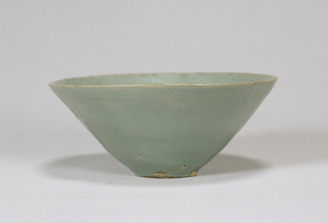
The glaze exhibits a clear green color, and the advancement of firing technology has resulted in a high degree of completion as a magnetic blue material. A flat part in the center of expectation is called the naiteienkoku. The bottom part is the snakeskin base, and four white refractory clay eyes (taikadome) remain.
釉薬は澄んだ青緑色を呈しており、焼成技術の向上によって、青磁としての完成度が高まっているさまがうかがえます。見込み中央に内底円刻(ないていえんこく)とよばれる平らな部分があります。底部は蛇の目高台で、白色耐火土目(たいかどめ)が4つ残されています。
View the original at Japan Search →A statute built to coax privately held work onto public walls. An owner registers a piece with the Commissioner for Cultural Affairs, then contracts with a museum to display it. Article 2 defines a work of art broadly, as paintings, sculpture, crafts and other tangible cultural products that are movable, which is the legal way of saying anything you could carry out of the house.
The cool part. The terms are the interesting part. Article 2 requires the public display contract to run for five years or more, and to contain a clause stating that the parties may not give notice of cancellation. You cannot lend a masterpiece for the tax treatment and then reclaim it when the market turns. Japan concluded the barrier to seeing art was never storage. It was ownership, and the fix was a contract you cannot walk out of.
Verify at e-Gov 法令検索 →Use it The border is the idea. Use it as an edge treatment and leave the centre empty.
Description source: museum curator text, translated — not generated