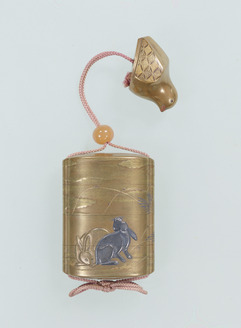
The inrō is a portable container worn hanging from the waist. It not only served a practical purpose but also functioned as an elegant accessory. In this piece, there is a scene of a deer in an autumn field, with a pair of gold and silver deer facing each other. The red-eyed white deer drawn in silver gazes up at something in the sky. When flipped over, a large crescent moon appears on the reverse side.
印籠は腰から提(さ)げて用いる携帯用容器。実用のほか、意を凝(こ)らした装身具としても機能しました。本作には秋の野に、金銀一対(いっつい)の兎が高蒔絵(たかまきえ)で表されています。銀で描く赤い目の白兎は、天を仰いで何かを見つめています。裏を返すと、そこに大きな三日月が現れる趣向です。
View the original at Japan Search →A statute built to coax privately held work onto public walls. An owner registers a piece with the Commissioner for Cultural Affairs, then contracts with a museum to display it. Article 2 defines a work of art broadly, as paintings, sculpture, crafts and other tangible cultural products that are movable, which is the legal way of saying anything you could carry out of the house.
The cool part. The terms are the interesting part. Article 2 requires the public display contract to run for five years or more, and to contain a clause stating that the parties may not give notice of cancellation. You cannot lend a masterpiece for the tax treatment and then reclaim it when the market turns. Japan concluded the barrier to seeing art was never storage. It was ownership, and the fix was a contract you cannot walk out of.
Verify at e-Gov 法令検索 →Use it Take the ratio, not the picture. It sets a page better than a grid does.
Description source: museum curator text, translated — not generated