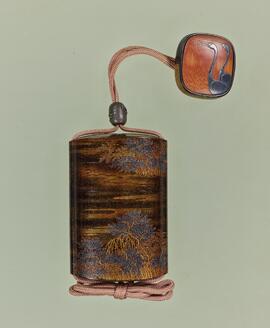
Inrō is a small container with medicine inside, held at the waist. From the Edo period onwards, it was used more as an accessory than a practical item. Essentially, inrō and its companion items, such as tobacco pouches and sashes, were used to hold down items hung at the waist. Inrō and its accessories were also garments that reflected the wearer's preferences and the diverse artistic inclinations of the craftsmen. (2004/09/01 or 2006/08/29)
印籠は、薬を入れて腰に提げる小さな容器。江戸時代中頃以降は実用品というより、アクセサリーとして用いられることが多かった。 根付は、印籠や煙草入・巾着などを腰に下げるためのホルダー。印籠・根付はつける人の趣味を表わす格好の装身具であり、形や意匠にさまざまな趣向が凝らされている。 (2004/09/01_h101 or 2006/08/29_h101)
View the original at Japan Search →Article 2 defines a museum as an institution that collects, keeps and displays materials on history, art, folklore, industry and natural science for public use, carries out research on them, and which has been registered under Chapter 2 of this Act. The registration is not decorative. In law, an unregistered collection open to the public is not a museum.
The cool part. The definition of keeping is given as including raising. That single parenthesis is why a zoo, an aquarium and a botanical garden sit inside museum law in Japan: the collection is allowed to be alive. Article 1 also grounds the statute in the Social Education Act and the Basic Act on Culture and the Arts, which places museums in education first and culture second.
Verify at e-Gov 法令検索 →Use it A motif small enough to blind-deboss, which is where restraint actually shows.
Description source: museum curator text, translated — not generated