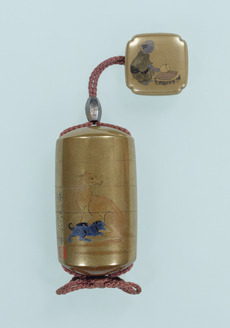
The inrō is a small container hung around the waist. Starting from the Edo period, it was used more as an accessory than a practical item. This inrō has a design of a mother dog and her pup on its surface. The painting on the lower part is by the representative inrō painting master of the late Edo period, Kobayashi Bunmei, from the Fukunoya school.
印籠は薬を入れて腰に提げる小さな容器。江戸時代中頃以降は実用品というより、装身具(アクセサリー)として用いられることが多かった。この印籠は表面に犬の親子を研出蒔絵で描いている。狩野養川院の下絵で、江戸時代後期の代表的印籠蒔絵師・古満寛哉の作。
View the original at Japan Search →A statute built to coax privately held work onto public walls. An owner registers a piece with the Commissioner for Cultural Affairs, then contracts with a museum to display it. Article 2 defines a work of art broadly, as paintings, sculpture, crafts and other tangible cultural products that are movable, which is the legal way of saying anything you could carry out of the house.
The cool part. The terms are the interesting part. Article 2 requires the public display contract to run for five years or more, and to contain a clause stating that the parties may not give notice of cancellation. You cannot lend a masterpiece for the tax treatment and then reclaim it when the market turns. Japan concluded the barrier to seeing art was never storage. It was ownership, and the fix was a contract you cannot walk out of.
Verify at e-Gov 法令検索 →Use it Palette for a single-colour run: one ink, heavy stock, nothing else on the sheet.
Description source: museum curator text, translated — not generated