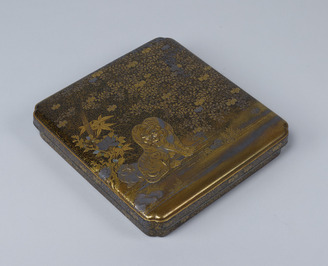
A bamboo basket with a design combining bamboos, peonies, and tigers. The tigers, male and female, have expressions and postures resembling cats, and are depicted in a more three-dimensional way through high relief painting. The glass is embedded in their eyes. Inside, there are depictions of waterfalls and monkeys. The work is intricately made, but gives off a somewhat bothersome impression.
竹や牡丹に虎の図と桐唐草文様を組み合わせた、変わったデザインの硯箱。雌雄の虎は猫のようなしぐさと表情で、高蒔絵により立体的に表わされ、目にはガラスを嵌めている。内側には観瀑図や猿などが描かれており、精巧な作行だが、やや煩雑な印象を与える。
View the original at Japan Search →Article 1 sets a purpose larger than preservation: to preserve cultural properties AND to make use of them, contributing to the cultural advancement of the people and to the progress of world culture. Article 4 turns that outward. An owner must recognise the object as a precious national asset, preserve it for the public, and make it public as far as possible. Ownership here carries a duty to show.
The cool part. "Living National Treasure" appears nowhere in the statute. Article 71 requires that when an Important Intangible Cultural Property is designated, the minister must also certify its holder or holding group. Japan does not register the pot, it registers the potter. Article 96 is the one that reaches ordinary people: if you uncover a shell mound, a dwelling site or a tumulus, you must leave it exactly as it is and notify the Commissioner for Cultural Affairs without delay, and the Commissioner can freeze the ground for up to three months.
Verify at e-Gov 法令検索 →Use it The border is the idea. Use it as an edge treatment and leave the centre empty.
Description source: museum curator text, translated — not generated