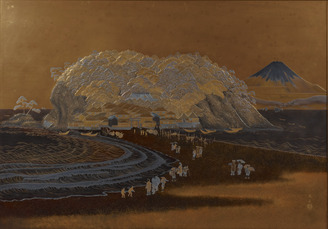
Heida Taisuke learned lacquer art from Isshin Shibata (Chiba Zeshin), a master of lacquer art during the Meiji period. He became a lacquer artist in the Imperial Court. This work was exhibited at the World's Columbian Exposition in Chicago in Meiji 26 (1893). It features a unique three-dimensional representation of gold leaf in lacquer art, with perspective techniques woven together. The work contrasts the dignity of the depicted landscapes with human portraits.
池田泰真は、明治期漆芸の大家・柴田是真[しばたぜしん]に漆芸を学び、帝室技芸員となった蒔絵師。本作は明治26年(1893)のシカゴ万博に出品された泰真の代表作です。金地に高蒔絵という蒔絵独自の立体表現に遠近法を織り交ぜ、人物像と対比された景物の威容を描いています。
View the original at Japan Search →A national statute written for one city. Article 1 recites the beauty of Kyoto and its historically, culturally and artistically important position in the world, and gives two purposes: to raise international culture and serve the ideal of permanent world peace, and to contribute to the economic recovery of Japan. It was passed five years after the war ended.
The cool part. Article 3 lets Kyoto designate culture tourism preservation districts and, by ordinance, prohibit building, rebuilding, removal, changes to the shape of the land and the cutting of bamboo, trees and stone, with compensation for ordinary loss. Then Article 4 does something statutes almost never do. It places a duty on the mayor personally: in the spirit of local autonomy, and with the cooperation of residents, the mayor must engage in ceaseless activity to complete the city. Nara received its own Act, number 250, the day before.
Verify at e-Gov 法令検索 →Use it A motif small enough to blind-deboss, which is where restraint actually shows.
Description source: museum curator text, translated — not generated