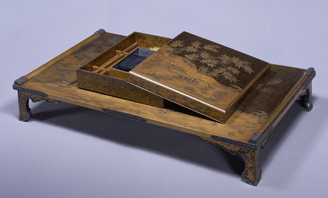
This set consists of a writing stand made of wood, coated with black lacquer and decorated with gold and silver powder paintings, and a box for storing inkstone and brushes. The design features mountains with thickly powdered foliage, such as bamboo and maple leaves, as well as calligraphy brushes and papers, all meticulously carved in silver. The inkstone and bird are attached to the writing stand with silver mounts. The intricate gold and silver powder paintings and luxurious mounts well represent the characteristics of the era. The back of the writing stand and the bottom of the inkstone box bear paintings of bamboo and maple leaves, symbolizing the Autumn scenery. The bamboo and maple leaves depicted are carried by a monk, a practitioner of the "Shugendo" (ascetic way), climbing a mountain to worship deities. The sword depicted next to the monk is also a tool belonging to him. A letter is placed on top of the stand. What does this motif signify? These depictions may represent a scene from "The Tale of Genji," a classic Japanese literary work, featuring the nobleman Ariwara no Narihira. While traveling from Kyoto to the east, he encounters a pass in Shizuoka Prefecture called Utosuyatoi. The pass, known as the "Bamboo Narrow Path," was an old road. Narihira encounters a hermit monk there and leaves a poem for the woman he left behind in Kyoto.
懐紙(かいし)や短冊(たんざく)などの紙をのせる台と、硯や筆などの筆記具を入れるための箱のセットです。全体は木製で、黒漆を塗り、金粉や銀粉を蒔き付ける蒔絵の技法でデザインが描かれています。山や土坡(どは)は粉(ふん)を密に蒔き付け、蔦(つた)や楓(かえで)の葉は少し厚みをもたせた高蒔絵であらわされています。笈(おい)や鳥は銀製の金具を貼り付けたものです。文台のいたるところに打たれた金具も銀製で、精緻な彫刻が施されています。洗練された緻密な蒔絵や豪華な金具が、時代の特色をよく示しています。文台の裏と硯の下に蒔絵で記された「田付長兵衛」は、江戸時代17世紀後半に活躍した蒔絵師です。 文台の表や硯箱の裏には、蔦や楓など秋の景色の中に置かれた笈が描かれています。笈は山の中で修行を行い神や仏を信仰する「修験道」(しゅげんどう)の修行者が背負うものです。笈の横に描かれている斧(おの)もやはり修験者(しゅげんじゃ)の持ち物です。笈の上には、両端を結んだ手紙が置かれています。こうしたモチーフが意味するものは何でしょうか。これらは、9世紀に活躍した貴族、在原業平(ありわらのなりひら)を主人公とする『伊勢物語』の中の一場面を象徴していると考えられます。恋多き男、在原業平は、京都から東に向かう旅の途中、静岡県にある宇津ノ谷峠(うつのやとうげ)にさしかかります。峠を越える道は、「蔦の細道」(つたのほそみち)として知られた古道でした。業平はここですれちがった修験者に、都に残してきた女に送る和歌を託します。硯箱の内側の鳥も、在原業平になじみ深い「都鳥」(みやこどり)を意図したものでしょう。『伊勢物語』のような文学作品は、古典文学として後の時代にも親しまれ、物語を主題とする絵画や工芸品がつくられました。ここでは人物を一切描かず、象徴的なモチーフで物語の場面を暗示しているのです。 『伊勢物語』第九段のうち、文台は「蔦細道」の意匠とし、硯箱は蓋表が「蔦細道」、内部は「角田川」の場面を描いています。薄肉高蒔絵を主体に、笈に結び文・都鳥など主要モチーフに銀製金物を据えています。当時知られた名物硯箱を、真摯に写したものと見られます。
View the original at Japan Search →Article 1 sets a purpose larger than preservation: to preserve cultural properties AND to make use of them, contributing to the cultural advancement of the people and to the progress of world culture. Article 4 turns that outward. An owner must recognise the object as a precious national asset, preserve it for the public, and make it public as far as possible. Ownership here carries a duty to show.
The cool part. "Living National Treasure" appears nowhere in the statute. Article 71 requires that when an Important Intangible Cultural Property is designated, the minister must also certify its holder or holding group. Japan does not register the pot, it registers the potter. Article 96 is the one that reaches ordinary people: if you uncover a shell mound, a dwelling site or a tumulus, you must leave it exactly as it is and notify the Commissioner for Cultural Affairs without delay, and the Commissioner can freeze the ground for up to three months.
Verify at e-Gov 法令検索 →Use it Take the ratio, not the picture. It sets a page better than a grid does.
Description source: museum curator text, translated — not generated