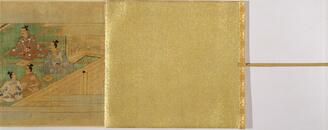
This work depicts a story from the Heian period about Minamoto no Yorimitsu, a famous general, who dealt with the drunken monkey (shuten-douji) demon, a well-known tale. The main character is one of Minamoto no Yorimitsu's subordinates, named Tsurunooke (Watabe no Tsuruna), who is also known as the brave warrior called the Four Heavenly Kings. It is said that there was a monkey among the drunken monkey's attendants who escaped and took up residence on the roof of Rashomon (Rashoumon). Tsuruna was given a renowned sword by Yorimitsu and went to subdue the monkey. To his surprise, as he cut off the monkey's right arm and returned home, a sudden clap of thunder sounded, and the monkey took back its right arm. The first half of the story tells of this encounter. In the second half, Yorimitsu fell gravely ill. This time, it was the turn of the cow demon, Nyoroi-daki. Once again, Tsuruna was given a sword and went to subdue the demon. He managed to cut off its arm, but this time, his mother, who had transformed into the cow demon, came to retrieve it. The sword used to subdue the demons in these encounters later became part of the Minamoto clan's legacy. The author and origin are unknown, but it is believed that it was created by a prominent warrior family related to the Minamoto clan.
この作品は、平安時代の武将、源頼光(みなもとのよりみつ)が酒呑童子(しゅてんどうじ)という鬼の頭領を退治する有名な物語の後日談を描いたものです。 主人公は、頼光の部下で、四天王(してんのう)と呼ばれた勇猛な武将のひとり、渡辺綱(わたなべのつな)です。 なんと、酒呑童子の配下の鬼が1匹逃げ延びて都の羅生門(らしょうもん)の上に住みついているというではありませんか。綱は、頼光から名刀を授けられ、鬼を退治にしに行きました。見事、鬼の右腕を切って、持ち帰ったところ、突如雷鳴がとどろき、鬼に右腕を取り返されてしまいました。ここまでが前半のお話。 後半では、頼光が重い病にかかってしまいます。今度は牛鬼ののろいだということで、ふたたび名刀を授けられた綱が、退治に行きました。牛鬼の腕を切って持ち帰ったのですが、今度は、綱の母親に化けた牛鬼が腕を取り返しにきます。 この鬼退治の際の名刀は、のちに源氏に伝わりました。 作者や伝来はわかっていませんが、おそらく源氏の流れをくむ武家がつくらせたものでしょう。 頼光四天王の一人、渡辺綱のスピンオフ作品にして、酒呑童子の物語の後日談です。酒呑童子が退治された後、そこから逃げ出し、羅生門に住んでいた鬼を綱が退治するという話と、頼光を病気にさせた牛鬼の腕を綱が切り落とすという話です。渡辺綱の人気は抜群だったようです。 らしょうもん、うしおに
View the original at Japan Search →Unusually for a Japanese statute it opens with a preamble, which states that finding joy in creating culture and living among it is an unchanging wish of people, and that culture contributes to world peace. Article 2 then sets the principles: the autonomy of those who make culture must be fully respected, and their creativity, standing and capacity considered.
The cool part. Article 2, paragraph 3 is the line worth reading twice. It says that creating and receiving culture is a right people are born with, and requires an environment in which citizens can appreciate, participate and create regardless of age, disability, economic situation, or the area they live in. Four barriers named in statute, one of which is your postcode. It puts the arts in the same grammatical register as infrastructure. Not a subsidy argued for each year, a standing obligation.
Verify at e-Gov 法令検索 →Use it Take the ratio, not the picture. It sets a page better than a grid does.
Description source: museum curator text, translated — not generated