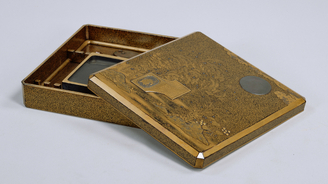
Cover to cover, a pillow is placed in an autumn field, and inside a thatched house, a man and woman are depicted hitting mortars. Autumn grasses and houses, as well as people, are delicately depicted using the technique of hatching. The characters "shiraRE" and "nuru" in the painting correspond to a verse in the "Choya Wakashu" volume 5 by a distinguished poet of the Heian period: "Unheard sound of clothes being pressed, far away a soft pillow, and a clump of moss." A box used for holding inkstone and brushes is called an inkstone box. This inkstone box is made of wood, with a lacquer finish and gold powder sprinkled on its surface, using the technique of "gold leaf." When the lid is opened, there is a thin container inside, on top of which is the inkstone and water dipper. The flat surface beneath the inkstone is used for holding pens and small knives. Let us take a look at the lid. On the upper right, there is a depiction of the moon and clouds. On the lower left, there are traditional autumn flowers such as thin (susuki), persimmon leaves (kikyou), a lady's fan (ominaeshi), and a pair of trousers (fujibakama). A lion-shaped pillow is placed among them. On the reverse side, there is a depiction of autumn grasses enclosing a house, with a man and woman inside, hitting mortars.
蓋表から蓋裏にかけて、秋の野に置かれた枕、板葺きの家の中で砧を打つ男女の姿などを描く。秋草や家屋、人物は、描割を駆使して精細に描き込まれている。画中の「しられ」「ぬる」の文字と合わせて、『千載和歌集』巻5の俊盛法師の歌「衣うつ音をきくにぞ知られぬる 里遠からぬ草枕とは」を表わしている。 筆記に用いる硯や筆などの道具を納めるための箱が「硯箱」です。この硯箱は木製で、表面に漆を塗り、金粉を蒔き付ける「蒔絵」の技法でデザインが表されています。蓋を開けると、身の内側には薄い容器が敷かれ、その上に硯(すずり)と水滴(すいてき)が置かれています。硯の上下に渡してある材は、筆や小刀を置くための台です。 蓋の表をみてみましょう。右上には月と雲を配し、左下には薄(すすき)・桔梗(ききょう)・女郎花(おみなえし)・藤袴(ふじばかま)など、日本で伝統的に好まれてきた秋の草花の中に、獅子をあらわした枕を置いています。これに対して蓋の裏側には、秋草に囲まれた家屋、その中で砧(きぬた)を打つ男女の姿があらわされます。砧は布をたたく道具で、たたくことによって柔らかくしたり、皺(しわ)をのばすために使われました。かつては秋の夜になると、家々から砧の音がしたといい、秋の夜を象徴するモチーフともなりました。 蒔絵は、部分に応じて、金粉を高く低く蒔き、あるいは線を描くなど、多彩な技法が駆使されています。ところどころに、実際の金銀の金属片を貼り付ける技法も効果的です。洗練された蒔絵の技法とスマートな硯箱の形が印象的な作品です。 蓋の表には秋草に紛れこませるように、「しられぬる」の文字が銀蒔絵で記されています。これは、平安時代12世紀の貴族、藤原俊盛(ふじわらのとしもり)が読んだ和歌「衣打つ音を聞くにぞ知られぬる里遠からぬ草枕とは ころもうつ おとをきくにぞ しられぬる さととおからぬ くさまくらとは」の一節です。蒔絵のデザインは、この和歌にもとづくものであることがわかります。このように、物語や和歌などの古典文学を題材としてデザイン化し、また文字自体をデザインの一部として取り込むやり方は、日本美術によくみられる特色です。それを理解するための教養が必要とされたことは、いうまでもありません。
View the original at Japan Search →Article 1 states the aim as a beautiful and dignified national land, and it covers not only cities but farming, mountain and fishing villages. Inside a landscape planning area, Article 16 requires advance notification of new building, extension, rebuilding, relocation, and any repair or alteration that changes the exterior. Landscape Districts go further and impose direct restrictions on the form and design of buildings.
The cool part. Read Article 16 to the end of the sentence. A change of colour is listed alongside new construction as an act you must notify. Repainting your building is, in law, the same category of event as putting up a new one. This is the machinery behind the muted shopfronts of Kyoto. The brown coffee-shop sign is not a marketing choice, it is compliance.
Verify at e-Gov 法令検索 →Use it A motif small enough to blind-deboss, which is where restraint actually shows.
Description source: museum curator text, translated — not generated