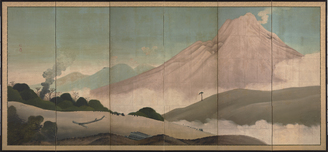
This is a painting from the Edo period, the largest known oil painting. In a recently discovered under-painting, a person chopping wood with an axe and a charcoal kiln attendant are depicted. However, in the main painting, only the swaying timber and charcoal smoke remain, creating a truly charming scene. The artist, Denzen Aou (Denzen of the Aou family), attempted to eliminate all cultural elements and focus solely on the landscape. A representative work of the technical school, this screen painting depicts Shinshu's Asama Mountain. The fact that a screen painting is rendered in oil is quite unusual. Denzen Aou was a scholar of lantern art who had connections with Europe. He studied European painting, producing copper plate prints and oil paintings. Against a blue sky background, a large pink mountain is depicted, with white smoke rising. In the foreground, a solitary tree is depicted as if about to topple. The left side of the ground is shown with timber tilting, and at the very edge, there are trees with leaves still intact, scattered haphazardly. It is a peculiar painting where one cannot see any children. Interestingly, there were several layers of under-paintings. On the left, there were depictions of a woodcutter and a charcoal kiln attendant. However, these eventually disappeared, leaving only the swaying timber and charcoal smoke on the ground.
江戸時代最大級の油絵。近年発見の下絵には、斧で木を割る人と炭焼き窯の番人がみられたが、本絵では転がる木材と炭焼きの煙だけが残り、実にシュールな景となった。徹底して風俗要素を排し、風景そのものを描こうとしたようだ。技巧派=田善の代表作。 信州の浅間山を描いた屏風です。屏風なのに油絵で描かれていて、とても珍しい感じがします。作者の亜欧堂田善(あおうどう でんぜん)はヨーロッパの文化を研究する蘭学者(らんがくしゃ)と交際がありました。西洋の絵画を研究し、銅版画や油絵を制作していました。 青い空を背景に、ピンクがかった大きな山が描かれ、白い煙があがっています。その手前に、木が一本だけぽつりと描かれています。画面の左側の地面には木材が転がり、さらに左端には葉を茂らせたままの木々が切り倒され、散乱しています。人っ子一人見えず、なんとも不思議な雰囲気の絵です。 実はこの作品には何段階か下絵がありました。左側には木を斧で割ろうとする人物と、炭焼き窯の番をする人物が描かれていましたが、最終的にはいなくなりました。その結果、地面に転がる木材と、炭焼きの煙だけが残ったようです。絵の主題が、風俗的なものから風景そのものに変わったことがうかがえます。 また、木材が地面に落とす影も、下絵では描かれていたのに、最後には消されています。全体に立体感や遠近感にとぼしく見えるのも、作者が意図的にめざしたことなのかもしれません。
View the original at Japan Search →Article 1 states the aim as a beautiful and dignified national land, and it covers not only cities but farming, mountain and fishing villages. Inside a landscape planning area, Article 16 requires advance notification of new building, extension, rebuilding, relocation, and any repair or alteration that changes the exterior. Landscape Districts go further and impose direct restrictions on the form and design of buildings.
The cool part. Read Article 16 to the end of the sentence. A change of colour is listed alongside new construction as an act you must notify. Repainting your building is, in law, the same category of event as putting up a new one. This is the machinery behind the muted shopfronts of Kyoto. The brown coffee-shop sign is not a marketing choice, it is compliance.
Verify at e-Gov 法令検索 →Use it A motif small enough to blind-deboss, which is where restraint actually shows.
Description source: museum curator text, translated — not generated