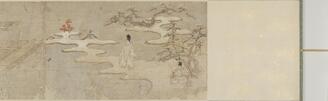
A princess who escaped from her stepmother's torment to Himeji, and a young soldier who fell in love with her at first sight. The building's solemn architectural lines, the powerful brushstrokes of trees and mounds, as well as the expressions and patterns of clothing, and various obstacle pictures in the painting, all deserve careful attention. (110920h_032) This is an ancient scroll painting that depicts the widely known "Tale of Himeji" from the Kamakura period. The main character of the story is a princess living in the capital city. She lost her mother early and was raised by her stepmother. A young soldier was deeply in love with the beautiful princess, but the cruel stepmother attempted to marry her off to him. However, the soldier's love for the princess remained unchanged, so the stepmother tried to kidnap her. In response, the princess escaped to Himeji. The soldier, determined to find her, received a dream revelation from Kannon in Longsha, and followed the beautiful sound of the lyre to Himeji where he finally met and united with the princess. They then returned to the capital and lived happily ever after. The wicked stepmother was eventually abandoned by her husband's chief minister. This is a heartwarming story with a happy ending. The painting in our museum collection depicts several scenes from the second half of the story.
継母からのいじめにより住吉へ逃れた姫君と、長谷観音の夢告と琴の音をたよりに彼女を探し当てた少将の恋物語。建物の謹直な定規引きの線、樹木や土坡の力強い筆さばきとともに、人物の表情、衣服の模様、画中の障子絵など、細部へのこだわりも見逃せない。(110920h_032) 鎌倉時代に広く知られていた「住吉物語」を描いた現存最古の絵巻です。 物語の主人公は、京の都に住む姫君です。姫君は早くに母を失い、継母に育てられました。少将という青年が美しく成長した姫君に想いを寄せますが、いじわるな継母は少将に自分の娘を引き合わせました。しかし、少将の姫君への想いは変わらなかったため、継母は姫君を誘拐しようとたくらみます。そこで、姫君は大阪の住吉に逃げていきました。どうしても姫君に会いたい少将は、長谷観音で夢のお告げを受けて住吉に行き、美しい琴の音をたよりに姫君と逢うことができました。こうして結ばれた少将と姫君は、都へ戻り幸せに暮らしました。いじわるな継母は事の次第を知った夫の中納言に捨てられてしまいました。めでたし、めでたし。 という、ハッピーエンドのお話です。 当館所蔵のこの絵巻は物語後半の一部を描いたもので、少将が姫をたずねて住吉に行く場面、姫君の住む館を探し当て、二人が出会いそして結ばれる場面、その後二人の婚礼を祝う酒盛の場面が描かれています。白い衣装を着ているのが少将です。姫君にだんだん近づいていくわくわく感を、少将の気持ちになって味わってみてください。 物語の展開を話の流れに沿って丁寧に描くスタイルは、物語絵巻の一つの特徴です。現代の私たちにもとてもわかりやすく、楽しくご覧いただけることでしょう。
View the original at Japan Search →A statute built to coax privately held work onto public walls. An owner registers a piece with the Commissioner for Cultural Affairs, then contracts with a museum to display it. Article 2 defines a work of art broadly, as paintings, sculpture, crafts and other tangible cultural products that are movable, which is the legal way of saying anything you could carry out of the house.
The cool part. The terms are the interesting part. Article 2 requires the public display contract to run for five years or more, and to contain a clause stating that the parties may not give notice of cancellation. You cannot lend a masterpiece for the tax treatment and then reclaim it when the market turns. Japan concluded the barrier to seeing art was never storage. It was ownership, and the fix was a contract you cannot walk out of.
Verify at e-Gov 法令検索 →Use it Take the ratio, not the picture. It sets a page better than a grid does.
Description source: museum curator text, translated — not generated