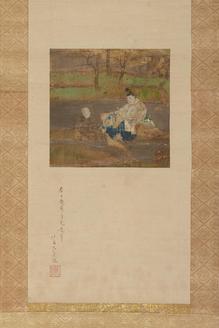
For a long time, a fragment of the "Genji Monogatari" (Tale of Genji) story about Wakamura Sakaki was believed to be a painting from the Muromachi period (1336-1573) related to the Genji Monogatari paintings. However, about 35 years ago, it was discovered that this piece is actually the same fragment used in the National Treasure, the Genji Monogatari Emaki (scrolls) of the Tokugawa Art Museum and the Five Islands Art Museum. This is a good example of how research can reevaluate an artwork's value. The Genji Monogatari, produced during the Heian period (794-1185) in the 11th century, is a long narrative that revolves around the romantic adventures and lavish lifestyle of the main character, Genji, and his family. Comprising 54 scrolls, this work depicts the actual situations of Heian court nobles. The Genji Monogatari Emaki refers to a compilation where selected scenes from each scroll are written down as captions, followed by the illustrations. The Genji Monogatari Emaki, which is housed in the Tokugawa Art Museum and the Five Islands Art Museum, is the oldest known surviving example of this collection. For a long time, this artwork was considered a part of the Genji Monogatari paintings from the Muromachi period.
長らく『源氏物語』若紫(わかむらさき)帖を描く室町時代の源氏絵と考えられてきた断簡。だが、今から約35年前、これが徳川・五島本源氏物語絵巻(国宝)の同帖を描くものであることが「発見」された。研究の進展が作品の「価値」を問い直したという好例である。 平安時代・11 世紀に制作された源氏物語は、主人公光源氏やその一族の恋愛や華々しい生活をつづった物語です。全部で54帖にもなる長編作で、当時の宮廷貴族の実情を描写しています。「源氏物語絵巻」とは、それぞれの帖の1~3場面を選び、物語の内容を文字で記した詞書(ことばがき)の後に、絵を描いて絵巻に仕立てたもののことです。12世紀に成立した、徳川美術館・五島美術館に所蔵されている源氏物語絵巻(国宝)は、現存する源氏物語絵巻の中で最も古い作品です。 この作品は長らく、室町時代につくられた源氏物語絵巻の一部と考えられていました。しかし、研究の結果、徳川美術館・五島美術館に伝わる12世紀の絵巻の一部であるということが、明らかになりました。 場面は、第五帖「若紫」の一部で、掛軸に仕立て直されています。「若紫」は病に侵された源氏が療養のために訪れた京都・北山で、のちに妻とする若紫(後の、紫の上)と出会うというお話です。描かれているのは、病気が治った源氏が京に帰る途中、咲き誇る桜の下で宴を開き、病気平癒を祈る加持を依頼した僧侶との別れを惜しんでいる場面です。源氏が屋外で宴を開けるほど回復したことを、象徴的に描いています。
View the original at Japan Search →A weapons statute that contains the most important art registry in the country. Article 2 defines a sword by measurement: a blade of fifteen centimetres or more for a sword, spear or naginata, five and a half for a dagger. Article 14 then carves out an exception. The prefectural board of education registers old firearms of value as art or antiques, and swords of value as art, on the basis of an appraisal by registration examiners appointed for their scholarly knowledge.
The cool part. A Japanese sword is lawful to own because it has been certified as art. Not because it was disarmed, not because it was licensed as a weapon. The judgement is made by the board of education, and Article 14 then requires the board to notify the prefectural public safety commission of what it has decided. The culture side rules, and the police are informed afterwards. Fail the appraisal and the same object becomes contraband.
Verify at e-Gov 法令検索 →Use it Take the ratio, not the picture. It sets a page better than a grid does.
Description source: museum curator text, translated — not generated