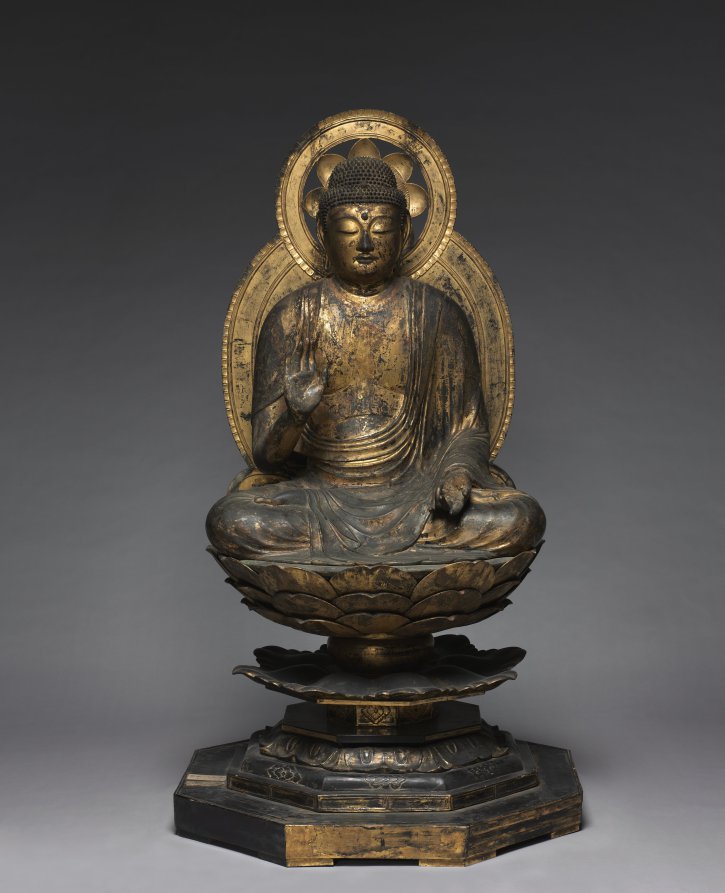
Composed of a number of hollowed-out pieces of wood that were then covered with lacquer and gilding, this sculpture served as an image of worship in one of the small temples surrounding Kōfukuji, a major Buddhist temple in Nara, Japan. Like many Buddhas, this figure has its right hand positioned in a gesture meaning "fear not." The left hand is a replacement, so its original gesture, a clue to this Buddha's identity, is unknown. However, as the left foot is exposed over the garment, in lotus position, it may have been created as a Medicine Master Buddha, Yakushi Nyorai in Japanese, or the Buddha of our era, Shakyamuni.
View the original at Cleveland Museum of Art →Japan implementing the 1970 UNESCO Convention. When a foreign state reports that cultural property has been stolen from an institution, the Ministry of Foreign Affairs notifies the education ministry, which designates the object as specified foreign cultural property, after consulting the trade ministry. Importing a designated object then requires approval under the foreign exchange and trade law.
The cool part. Article 6 quietly rewrites private law. Under the Civil Code a good-faith purchaser is normally secure against a recovery claim after two years. For designated stolen foreign cultural property, the victim may demand recovery from two years after the theft until ten years have passed. Buying in good faith does not settle the question for a decade, which is roughly how long it takes a stolen object to surface on a legitimate market.
Verify at e-Gov 法令検索 →Use it The border is the idea. Use it as an edge treatment and leave the centre empty.
Description source: museum curator text — not generated