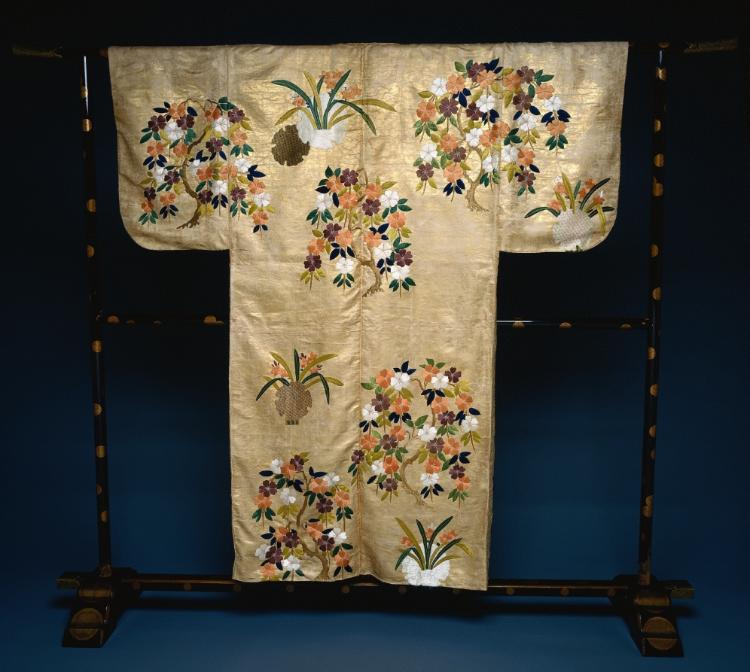
This magnificent robe was a costume specifically designed for performances of Noh theater in Japan. Originating during the 1300s from simple folk plays, Noh drama evolved into formal presentations of ritual, theater, dance, and music performed in the courts and shrines of the nobility. Stories were derived from a variety of sources—myths, legends, poetry, and prose—many dating back to the medieval period. Because great importance was placed on subtlety and elegance, plots tended to be minimal. Whether male or female all roles were played by men. Central to these performances were the masks and costumes worn by the actors. The brilliance and elegance of this robe are characteristic of costumes made solely for Noh theater. Its date in the first half of the 1700s is indicated by the proportions of the robe, the choice of embroidery stitches (satin, couching, and outline), and the absence of decoration at the hips, a fashion also reflected in kimonos at that time. The design of weeping cherry trees and irises in the snow was very likely inspired by a medieval Japanese poem. Robes decorated with embroidery against a gold ground were reserved for female roles. These robes were worn under the external garment and were only partially visible.
View the original at Cleveland Museum of Art →A craft cannot call itself traditional by taste or reputation. Article 2 sets five conditions, all of which must hold: it is used mainly in daily life, the main part of its making is by hand, it is made by traditional techniques, it is made chiefly from materials traditionally used, and a not-small number of people in a defined area still make it. The designation names the techniques, the materials and the region.
The cool part. Two conditions do quiet work. The first is daily use, so a technique kept alive only for display does not qualify. The fifth is the number of makers: the law will not protect a single surviving genius, because one person is a biography and not an industry. And because the region is written into the designation, the craft is legally attached to a place and cannot move.
Verify at e-Gov 法令検索 →Use it Two-colour foil on uncoated stock gets you most of this at production cost.
Description source: museum curator text — not generated