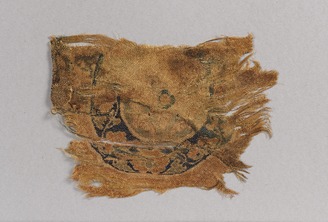
A silk fragment believed to have been excavated from tombs in China during the Liao Dynasty. Liao Dynasty silk pieces are rare and valuable. In China, this type of weaving is called "Liao-style oblique brocade." This is because multiple examples have been found in Liao tombs. This type of silk is also found in excavations from the Xiajiang Black Water Palace and surrounding areas. The silk fragment from the Black Water Palace excavation is similar in use and weaving to a silk piece in the Kyoto Shinto Temple's continuous record. This similarity suggests that a previously assumed silk piece from the Heian period is actually a loading silk piece. Heian period silk pieces, as well as Liao and Western Xia silk pieces and those of the Han nationalities' Northern Song Dynasty, are rare and few in number. The complete picture and trade routes of 9th-12th century silk pieces remain undisclosed. Liao silk pieces are valuable examples that can help solve these problems. This piece features a round design in East China Blue. It is bordered by a band of flower-pattern silk. The initial example of the flower-pattern silk border is also valuable as an early example of the flower-pattern silk motif.
中国・遼代の墳墓から出土したと思われる錦裂。遼代の染織品は遺例が少なく貴重である。中国ではこの種の織組織を「遼式斜紋緯錦」と呼称している。これは、遼墓から複数遺例が見つかっていることによる。この種の錦は、西夏の黒水城遺跡など遼周辺地域からも類例が出土している。黒水城遺跡出土の幡裂は、京都・神護寺伝来の一切経の経帙に使用される錦と文様が類似し、また織組織が共通する。これにより、近年、これまで平安時代の作であると考えられてきた錦が舶載裂であることが指摘されるようになった。平安時代の染織品や、遼や西夏と同時期に存在した漢民族国家・北宋の染織品は残存数が少なく、9-12世紀の染織品の全容や流通経路は解明されていない。遼代染織品はこれらの問題を解決する手がかりとなる貴重な作例である。本作は海東青を用いた丸文をあらわした錦裂。連珠を伴った菱文を地文にあしらう。海東青丸文の周囲は、花唐草文の帯で括る。ボタン花様をした花唐草文様の初期の例としても貴重である。
View the original at Japan Search →Article 1 states the aim as a beautiful and dignified national land, and it covers not only cities but farming, mountain and fishing villages. Inside a landscape planning area, Article 16 requires advance notification of new building, extension, rebuilding, relocation, and any repair or alteration that changes the exterior. Landscape Districts go further and impose direct restrictions on the form and design of buildings.
The cool part. Read Article 16 to the end of the sentence. A change of colour is listed alongside new construction as an act you must notify. Repainting your building is, in law, the same category of event as putting up a new one. This is the machinery behind the muted shopfronts of Kyoto. The brown coffee-shop sign is not a marketing choice, it is compliance.
Verify at e-Gov 法令検索 →Use it Take the ratio, not the picture. It sets a page better than a grid does.
Description source: museum curator text, translated — not generated