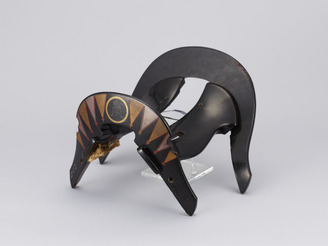
A round object resembling a horse saddle, with the outer surfaces of both the front and back wheels made flat. On the shoulders of the front wheel, there are carvings of hands. The entire body is coated in black lacquer. In the center of both wheel outsides, there is a gold and silver inlay picture and mother-of-pearl, surrounded by a round wooden circular emblem with the reversed swastika symbol in red lacquer. On the ends of the swastika symbol, there are decorations typically seen on Western architecture. This suggests that the craftsman who made this was influenced by the popular southern barbarian script style during the late period. It is believed that this plain saddle was decorated with South Chinese motifs in later periods. Unfortunately, there is no clear information about the origin or owner of this valuable example that shows the spread of foreign interests.
前輪・後輪の外側を平らとするいわゆる海無鞍で、前輪の肩に手形を刳る。総体黒漆地とし両輪外側中央には、金銀平蒔絵と金貝、朱漆で丸に木字逆卍紋、その左右には先端に頂華をつけた鋸歯文を表す。鋸歯文の端部には、西洋建築で見られる頂上飾りが描かれており、この意匠が近世に入って流行する南蛮文様の類であることがわかる。鞍橋と蒔絵の年代に開きがあるから、おそらく無文の鞍橋に後世、南蛮風の加飾を施したものであろう。伝来や所用者などの詳細は残念ながら不明であるが、異国趣味の広まりが感じられる貴重な作例である。
View the original at Japan Search →A statute built to coax privately held work onto public walls. An owner registers a piece with the Commissioner for Cultural Affairs, then contracts with a museum to display it. Article 2 defines a work of art broadly, as paintings, sculpture, crafts and other tangible cultural products that are movable, which is the legal way of saying anything you could carry out of the house.
The cool part. The terms are the interesting part. Article 2 requires the public display contract to run for five years or more, and to contain a clause stating that the parties may not give notice of cancellation. You cannot lend a masterpiece for the tax treatment and then reclaim it when the market turns. Japan concluded the barrier to seeing art was never storage. It was ownership, and the fix was a contract you cannot walk out of.
Verify at e-Gov 法令検索 →Use it Take the ratio, not the picture. It sets a page better than a grid does.
Description source: museum curator text, translated — not generated