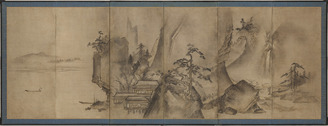
In the scene by the water's edge, a nobleman with a red maple and coolness is depicted. This painting has a spring and summer landscape as its subject, and it is believed to have originally been part of a six-scroll and double-fold screen called the Four Seasons WaterScene Screen. There are no seals or signatures on the painting, but the straight trunks of the cedar trees and the curved trunks of the bamboo, which suggest leaves, reveal the learning of the painter, who is believed to have been a Tangochi Temple priest in Nara, known as the Nara Art Appreciation Master. It is said that the Nara Art Appreciation Master studied under the Imperial House of Soga's court painter, Zhouwen. The landscape painting depicts the representation of trees and rocks, which concretely shows the achievements of Zhouwen's learning. This painting is valuable as the only large-scale painting by the Muromachi period watercolor painter, Amematsu- no-Kunisada, known as the Nara Art Appreciation Master. Additionally, it is one of the approximately ten surviving examples of Muromachi period watercolor landscape screens in the Zhouwen style.
水辺の景観のなかに紅梅と涼をとる高士が描かれる。本図は春夏の情景を題材としており、当初は四季山水図屏風(6曲1双)の右隻であったと考えられる。画面に落款や印章はないが、幹が真っすぐ伸びる車輪松や、幹が弧を描いて伸び点描で葉を表わす竹の描写、全体的に整理された平明な構成から、筆者は唐招提寺総持坊に住した律僧で奈良法眼と呼ばれた鑑貞と考えられる。鑑貞は足利将軍家の御用絵師・周文に学ぶと伝えられ、この屏風絵は樹木や岩塊の表現に彼の周文学習の成果が具体的に示されている。本図は、室町時代に活躍した水墨画家・鑑貞の唯一の大画面絵画として貴重であり、また約10件のみが現存する室町水墨画の周文系山水図屏風の1つとして大きな意義をもつ。
View the original at Japan Search →Article 2 defines a museum as an institution that collects, keeps and displays materials on history, art, folklore, industry and natural science for public use, carries out research on them, and which has been registered under Chapter 2 of this Act. The registration is not decorative. In law, an unregistered collection open to the public is not a museum.
The cool part. The definition of keeping is given as including raising. That single parenthesis is why a zoo, an aquarium and a botanical garden sit inside museum law in Japan: the collection is allowed to be alive. Article 1 also grounds the statute in the Social Education Act and the Basic Act on Culture and the Arts, which places museums in education first and culture second.
Verify at e-Gov 法令検索 →Use it Two-colour foil on uncoated stock gets you most of this at production cost.
Description source: museum curator text, translated — not generated