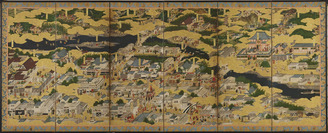
This catalog text describes the detailed depiction of the streets of Kyoto's Roku-chuu (downtown) and Roku-gai (outskirts). The Roku-chuu Roku-gai Edo-style maps were produced in abundance from the late Muromachi period to the Edo period, with approximately 170 pieces surviving presently. This particular map places Hoouji Temple on the right side, and Nijou Castle on the left side, dividing the Kyoto scenery from east to west. The screen size is smaller than a typical byobu (folding screen), and the shop curtains (noren) display detailed family crests. Based on the characteristics of the depicted buildings, it is believed to be a representation of Kyoto during the Bun-ei era (around 1624-1652).
京都の洛中(市街)と洛外(郊外)の街並みを細やかに描き出す。洛中洛外図は、室町時代の後期から江戸時代にかけて盛んに制作され、現在も約百七十件の作品が伝わっている。本図は、右隻に豊臣秀吉が発願した方広寺(ほうこうじ)を、左隻に徳川家康が造営した二条城(にじょうじょう)を配して、京の景観を東西に分けて表わす。画面は通常の屏風よりも一回り小さいものの、商店の暖簾(のれん)には家紋が詳しく表わされるなど描写は非常に丁寧である。登場する建物の特徴から、およそ寛永年間(一六二四~四五)の京都の景観を描いたものと考えられる。
View the original at Japan Search →A statute built to coax privately held work onto public walls. An owner registers a piece with the Commissioner for Cultural Affairs, then contracts with a museum to display it. Article 2 defines a work of art broadly, as paintings, sculpture, crafts and other tangible cultural products that are movable, which is the legal way of saying anything you could carry out of the house.
The cool part. The terms are the interesting part. Article 2 requires the public display contract to run for five years or more, and to contain a clause stating that the parties may not give notice of cancellation. You cannot lend a masterpiece for the tax treatment and then reclaim it when the market turns. Japan concluded the barrier to seeing art was never storage. It was ownership, and the fix was a contract you cannot walk out of.
Verify at e-Gov 法令検索 →Use it Two-colour foil on uncoated stock gets you most of this at production cost.
Description source: museum curator text, translated — not generated