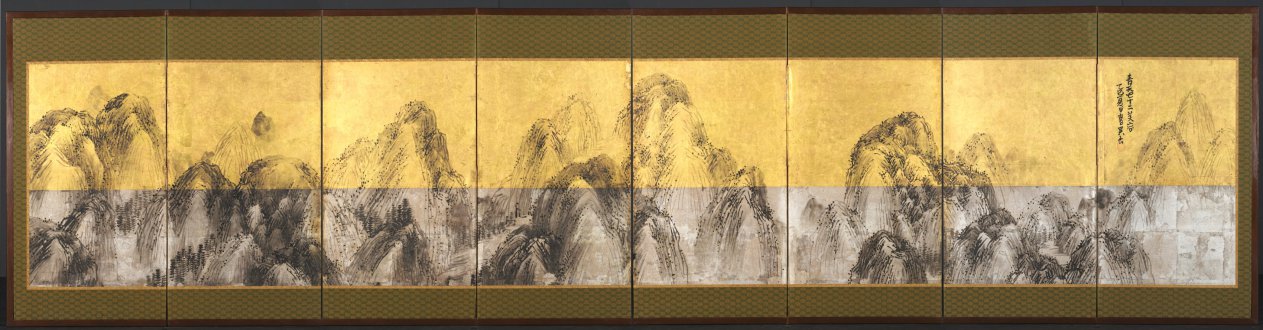
This folding screen is relatively low, indicating its function as a divider in a small tearoom. The depicted scene is identified as the 72-peak Heng mountain range located in Hunan, China. This range is significant in Buddhist and Daoist traditions and has been the subject of numerous poems. The inscription specifically mentions Mount Furong, one of the peaks within this range. Matsumura Goshun may have been influenced by his teacher, Yosa Buson (1716–1783), whose last work showcased the same mountain range.
The low height of this folding screen suggests its use as a partition in a small tearoom. An inscription identifies the scene as the 72-peak Heng mountain range in Hunan, China, associated with Buddhist and Daoist traditions and celebrated in poetry. Special mention in the inscription is made of Mount Furong, one of the peaks in the range. Matsumura Goshun may have drawn inspiration from his teacher, Yosa Buson (与謝蕪村) (1716–1783), whose final work depicted the same mountain range.
View the original at Cleveland Museum of Art →Article 1 gives three grounds for regulating a sign: forming good landscape, maintaining scenic character, and preventing danger to the public. Article 3 then lets a prefecture prohibit outdoor advertising outright, by ordinance, in named categories of place.
The cool part. Read the list in Article 3 and it stops being an advertising law. The places where signage can be banned include landscape districts, scenic districts, preservation districts for groups of traditional buildings, the surroundings of designated Important Cultural Properties, and historic sites, places of scenic beauty and natural monuments. The statute protects the view by removing the sentences written across it.
Verify at e-Gov 法令検索 →Use it A motif small enough to blind-deboss, which is where restraint actually shows.
Description source: museum curator text, translated — not generated