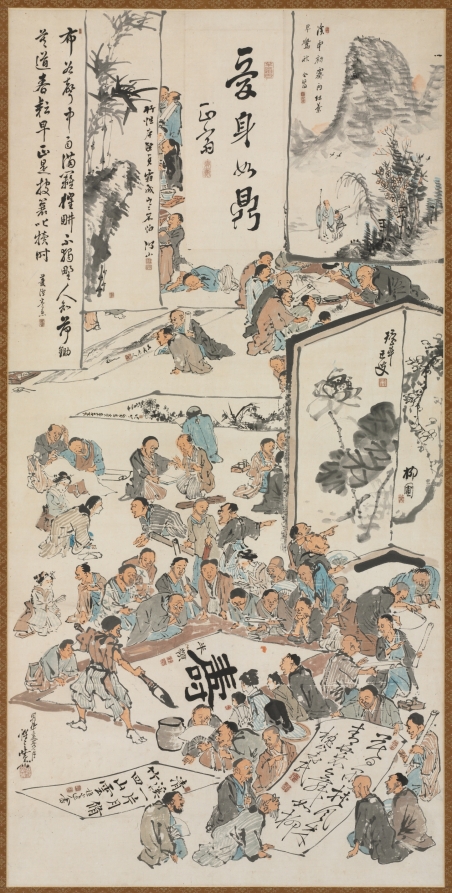
hanging scroll; ink and color on paper · Japan, Meiji period (1868–1912) · Painting only: 139 x 69 cm (54 3/4 x 27 3/16 in.); Including mounting: 221 x 97.5 cm (87 x 38 3/8 in.) · Japanese Art
In this collaborative painting, artists create works in response to patrons’ requests. Kawanabe Kyōsai painted the figures and outlines of the screens and scrolls, and 10 bunjin completed them. Each calligraphy and painting has a signature. Physician and calligrapher Nakane Hanrei (中根半嶺) (1831–1914) wrote “longevity” (壽) with an enormous ink-filled brush. Painter Fukushima Ryūho (福島柳圃) (1820–1889) did the plum on the folding screen, while Matsuoka Kansui (松岡環翠) (1818–1887) did the lotus; the two seem to be standing nearby, pointing others toward their accomplishment.
View the original at Cleveland Museum of Art →Article 1 states the aim as a beautiful and dignified national land, and it covers not only cities but farming, mountain and fishing villages. Inside a landscape planning area, Article 16 requires advance notification of new building, extension, rebuilding, relocation, and any repair or alteration that changes the exterior. Landscape Districts go further and impose direct restrictions on the form and design of buildings.
The cool part. Read Article 16 to the end of the sentence. A change of colour is listed alongside new construction as an act you must notify. Repainting your building is, in law, the same category of event as putting up a new one. This is the machinery behind the muted shopfronts of Kyoto. The brown coffee-shop sign is not a marketing choice, it is compliance.
Verify at e-Gov 法令検索 →Use it Take the ratio, not the picture. It sets a page better than a grid does.
Description source: museum curator text, translated — not generated