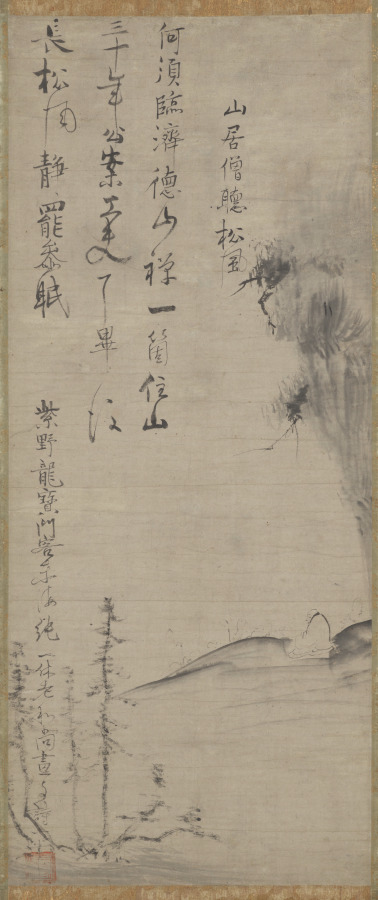
A monk sits in contemplation below an overhang covered with pine. The poem, titled "Monk in the Mountains Listening to the Wind in the Pines," refers to two Chinese Chan (Zen) Buddhist monks active in the ninth century. It may be translated as follows: Why must the Zen of Rinzai (Linji Yixuan) and Tokusan (Deshan Xuanjian) reside in a single temple for thirty years? Once he's solved his kōan, (the monk) ends his practice and falls asleep in the quietness of the wind among the tall pines. (translated by Osvaldo Mercuri) According to an inscription following the poem, both painting and verse were done by an eminent Japanese Buddhist monk known for revitalizing the Kyoto temple Daitokuji.
View the original at Cleveland Museum of Art →Japan implementing the 1970 UNESCO Convention. When a foreign state reports that cultural property has been stolen from an institution, the Ministry of Foreign Affairs notifies the education ministry, which designates the object as specified foreign cultural property, after consulting the trade ministry. Importing a designated object then requires approval under the foreign exchange and trade law.
The cool part. Article 6 quietly rewrites private law. Under the Civil Code a good-faith purchaser is normally secure against a recovery claim after two years. For designated stolen foreign cultural property, the victim may demand recovery from two years after the theft until ten years have passed. Buying in good faith does not settle the question for a decade, which is roughly how long it takes a stolen object to surface on a legitimate market.
Verify at e-Gov 法令検索 →Use it Take the ratio, not the picture. It sets a page better than a grid does.
Description source: museum curator text — not generated