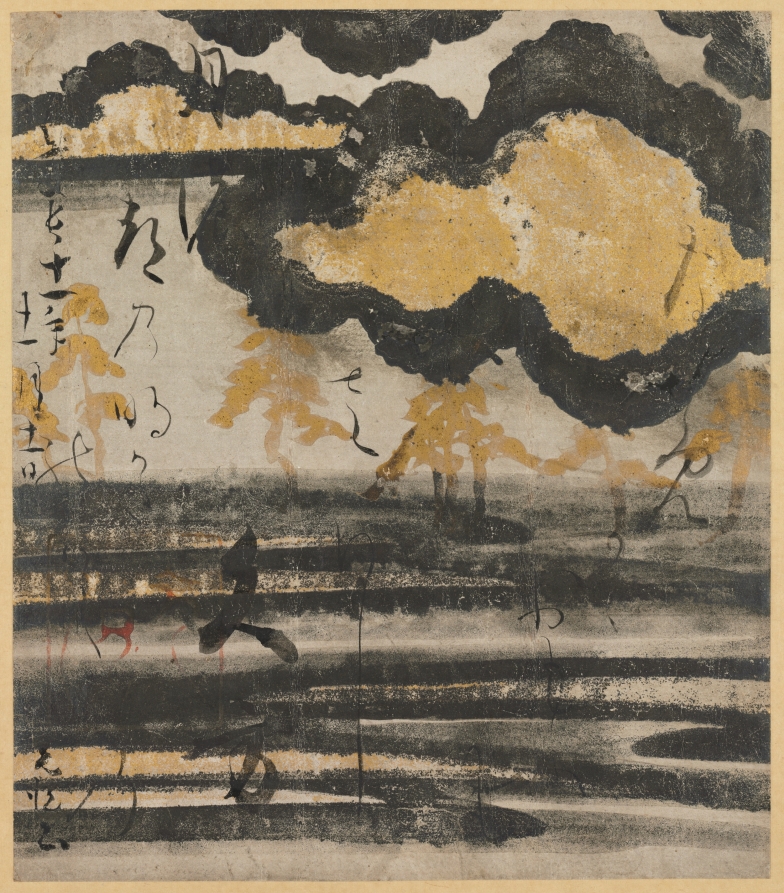
Tawaraya Sotatsu and Hon’ami Koetsu are both associated with the founding of the Rimpa school of Japanese painting. In this poem-card––one of 16 that survive––Tawaraya painted the gold and silver design, over which Hon’ami recorded poems from Shinkokin wakashu. The verses read from top to bottom and from right to left: "Even as I gaze, the thought of it is lonely. High in the heavens the moon-capital lies still in the sky of its dawning."
View the original at Cleveland Museum of Art →Japan implementing the 1970 UNESCO Convention. When a foreign state reports that cultural property has been stolen from an institution, the Ministry of Foreign Affairs notifies the education ministry, which designates the object as specified foreign cultural property, after consulting the trade ministry. Importing a designated object then requires approval under the foreign exchange and trade law.
The cool part. Article 6 quietly rewrites private law. Under the Civil Code a good-faith purchaser is normally secure against a recovery claim after two years. For designated stolen foreign cultural property, the victim may demand recovery from two years after the theft until ten years have passed. Buying in good faith does not settle the question for a decade, which is roughly how long it takes a stolen object to surface on a legitimate market.
Verify at e-Gov 法令検索 →Use it Two-colour foil on uncoated stock gets you most of this at production cost.
Description source: museum curator text — not generated