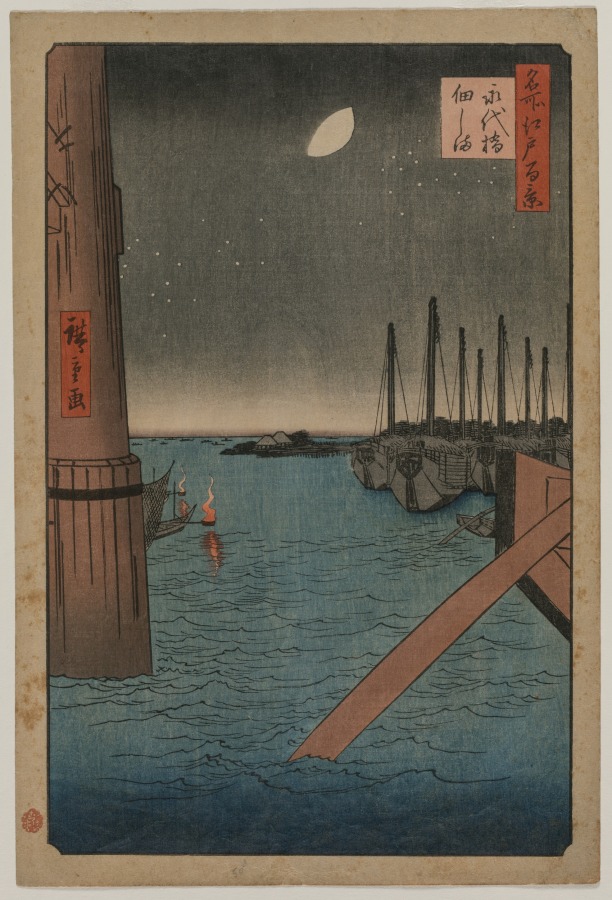
This woodblock print is from the series of landscape views of Edo, present-day Tokyo, from Hiroshige’s late career. The series title is in the dark red rectangular cartouche on the upper right, while the name of the print is in the pink square. Although Tsukudajima and Eitai Bridge are important enough to merit mentions in the title, the island is tiny and in the distance at the mouth of the river, and only part of a bridge piling is visible. Hiroshige’s dramatic composition instead foregrounds the oar of a passing boat. Other vessels in the middle distance moored under the starry sky. Fishing boats with burning torches to attract fish ply the water both near the bridge and beyond the island.
View the original at Cleveland Museum of Art →Article 1 states the aim as a beautiful and dignified national land, and it covers not only cities but farming, mountain and fishing villages. Inside a landscape planning area, Article 16 requires advance notification of new building, extension, rebuilding, relocation, and any repair or alteration that changes the exterior. Landscape Districts go further and impose direct restrictions on the form and design of buildings.
The cool part. Read Article 16 to the end of the sentence. A change of colour is listed alongside new construction as an act you must notify. Repainting your building is, in law, the same category of event as putting up a new one. This is the machinery behind the muted shopfronts of Kyoto. The brown coffee-shop sign is not a marketing choice, it is compliance.
Verify at e-Gov 法令検索 →Use it A motif small enough to blind-deboss, which is where restraint actually shows.
Description source: museum curator text — not generated