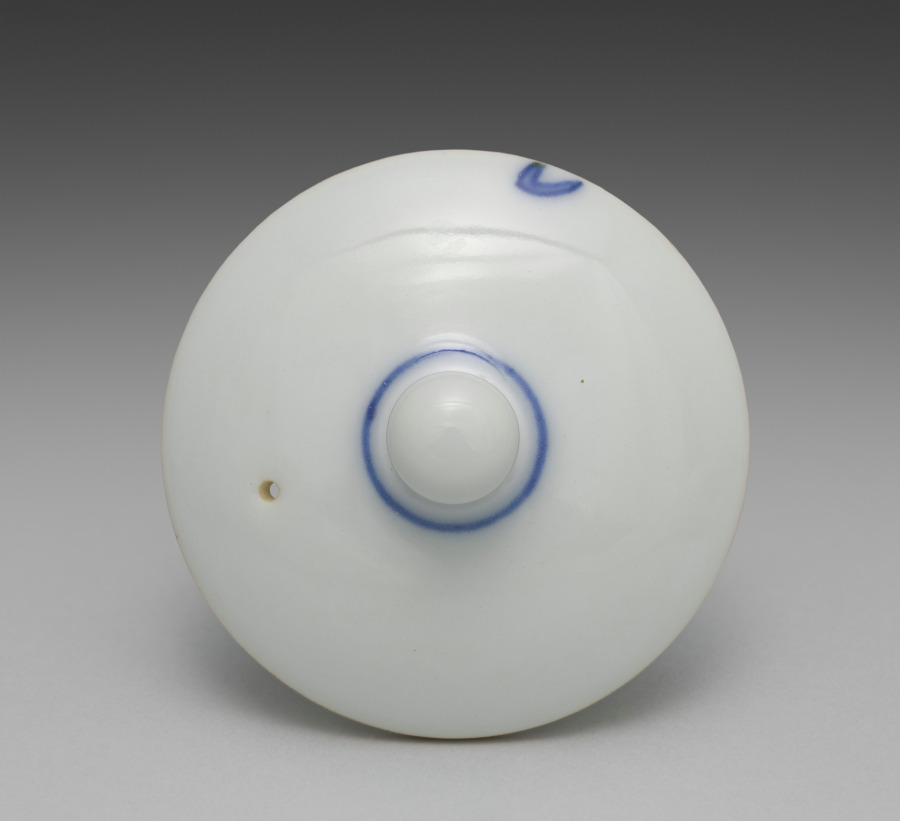
Although the teapot here is stored in a separate box from the five cups, these six pieces may once have been part of a tea set that included other tools such as a water cooler. The teacups have orchid flowers on both sides in underglaze blue, as well as a blue band inside the footring. The teapot has the same design and a blue band painted around the bottom of the lid’s knob. The cups’ long wood storage box is stamped on the exterior, over the lid and base, with a small red seal reading “Satō.” The same seal appears on five small squares of yellow textile, one placed in the bottom of each compartment in the teacup storage box. These are additional to the customary yellow cloths stamped with a “Seifu” seal. Interestingly, four of the Seifū cloths are stamped with an ovoid seal, while the remaining cloth, which is a slightly lighter color, has an unusual seal that is not quite gourd-shaped and with the fū of Seifū in a stylized, unrecognizable form. The teapot has its own box with a Satō seal and is wrapped with an orange textile stamped with the same unusual Seifū seal. A set with a very similar surface design is in the Brooklyn Museum. The Brooklyn set has a water cooler and a small pitcher, in addition to the teapot and cups, and all are in a single storage box.
View the original at Cleveland Museum of Art →Article 2 defines a museum as an institution that collects, keeps and displays materials on history, art, folklore, industry and natural science for public use, carries out research on them, and which has been registered under Chapter 2 of this Act. The registration is not decorative. In law, an unregistered collection open to the public is not a museum.
The cool part. The definition of keeping is given as including raising. That single parenthesis is why a zoo, an aquarium and a botanical garden sit inside museum law in Japan: the collection is allowed to be alive. Article 1 also grounds the statute in the Social Education Act and the Basic Act on Culture and the Arts, which places museums in education first and culture second.
Verify at e-Gov 法令検索 →Use it A motif small enough to blind-deboss, which is where restraint actually shows.
Description source: museum curator text — not generated